Question 2
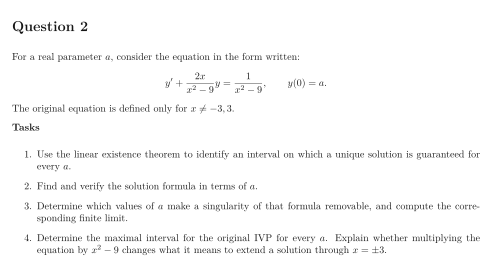
For a real parameter , consider the equation in the form written: The original equation is defined only for .
Tasks
Use the linear existence theorem to identify an interval on which a unique solution is guaranteed for every .
Find and verify the solution formula in terms of .
Determine which values of make a singularity of that formula removable, and compute the corresponding finite limit.
Determine the maximal interval for the original IVP for every . Explain whether multiplying the equation by changes what it means to extend a solution through .
Show solutionHide solution
Question 2 – Solution
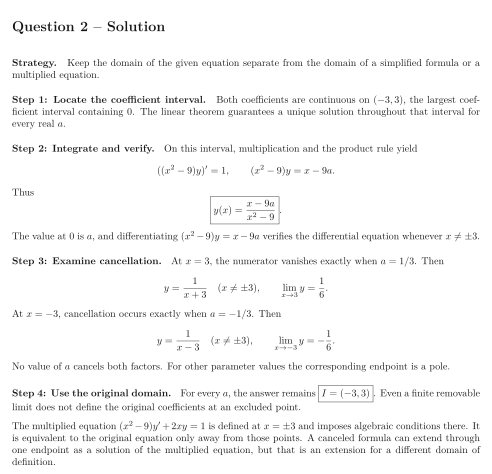
Strategy. Keep the domain of the given equation separate from the domain of a simplified formula or a multiplied equation.
Step 1: Locate the coefficient interval. Both coefficients are continuous on , the largest coefficient interval containing . The linear theorem guarantees a unique solution throughout that interval for every real .
Step 2: Integrate and verify. On this interval, multiplication and the product rule yield Thus The value at is , and differentiating verifies the differential equation whenever .
Step 3: Examine cancellation. At , the numerator vanishes exactly when . Then At , cancellation occurs exactly when . Then No value of cancels both factors. For other parameter values the corresponding endpoint is a pole.
Step 4: Use the original domain. For every , the answer remains . Even a finite removable limit does not define the original coefficients at an excluded point.
The multiplied equation is defined at and imposes algebraic conditions there. It is equivalent to the original equation only away from those points. A canceled formula can extend through one endpoint as a solution of the multiplied equation, but that is an extension for a different domain of definition.