Question 3
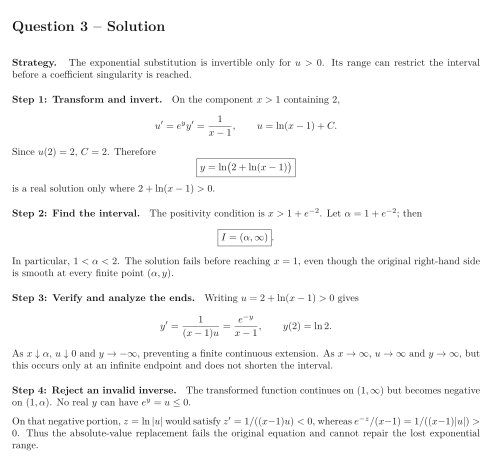
Consider with and real .
Tasks
Use to solve the IVP, explicitly enforcing the range of this substitution.
Determine the maximal interval containing ; compare its left endpoint with the singular point of the coefficient .
Verify the solution and calculate its limiting behavior at both ends of its maximal interval.
Explain why neither continuing the linear transformed solution through a zero nor replacing by produces a continuation of the original solution.
Show solutionHide solution
Question 3 – Solution
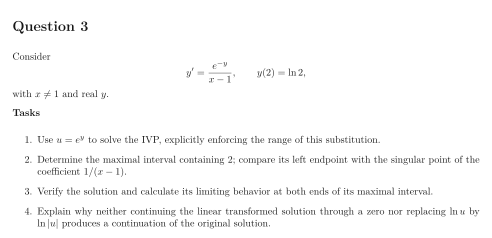
Strategy. The exponential substitution is invertible only for . Its range can restrict the interval before a coefficient singularity is reached.
Step 1: Transform and invert. On the component containing , Since , . Therefore is a real solution only where .
Step 2: Find the interval. The positivity condition is . Let ; then In particular, . The solution fails before reaching , even though the original right-hand side is smooth at every finite point .
Step 3: Verify and analyze the ends. Writing gives As , and , preventing a finite continuous extension. As , and , but this occurs only at an infinite endpoint and does not shorten the interval.
Step 4: Reject an invalid inverse. The transformed function continues on but becomes negative on . No real can have .
On that negative portion, would satisfy , whereas . Thus the absolute-value replacement fails the original equation and cannot repair the lost exponential range.