Question 9
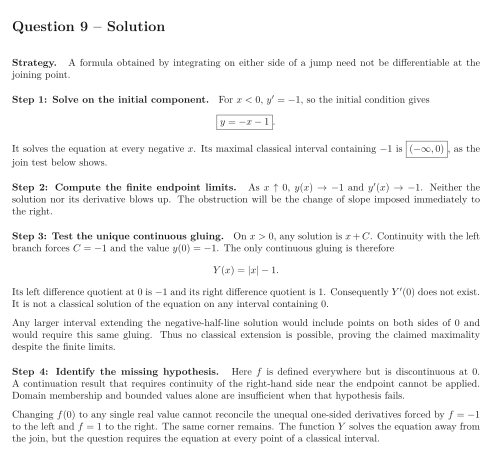
Define a real function on the entire real line by Consider with . Require a classical solution: is continuously differentiable on an open interval and the equation holds at every point.
Tasks
Find the IVP solution on and its maximal interval containing .
Compute the finite left-hand limits of and at .
Find the continuous function on that agrees with this solution on and solves the differential equation on . Decide whether it is a classical extension through .
Explain why this example does not contradict a continuation theorem requiring a continuous right-hand side. Would changing only repair the obstruction?
Show solutionHide solution
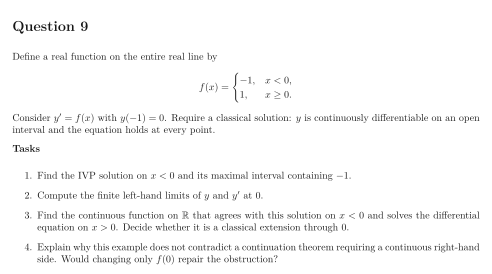
Question 9 – Solution
Strategy. A formula obtained by integrating on either side of a jump need not be differentiable at the joining point.
Step 1: Solve on the initial component. For , , so the initial condition gives It solves the equation at every negative . Its maximal classical interval containing is , as the join test below shows.
Step 2: Compute the finite endpoint limits. As , and . Neither the solution nor its derivative blows up. The obstruction will be the change of slope imposed immediately to the right.
Step 3: Test the unique continuous gluing. On , any solution is . Continuity with the left branch forces and the value . The only continuous gluing is therefore Its left difference quotient at is and its right difference quotient is . Consequently does not exist. It is not a classical solution of the equation on any interval containing .
Any larger interval extending the negative-half-line solution would include points on both sides of and would require this same gluing. Thus no classical extension is possible, proving the claimed maximality despite the finite limits.
Step 4: Identify the missing hypothesis. Here is defined everywhere but is discontinuous at . A continuation result that requires continuity of the right-hand side near the endpoint cannot be applied. Domain membership and bounded values alone are insufficient when that hypothesis fails.
Changing to any single real value cannot reconcile the unequal one-sided derivatives forced by to the left and to the right. The same corner remains. The function solves the equation away from the join, but the question requires the equation at every point of a classical interval.