Question 10
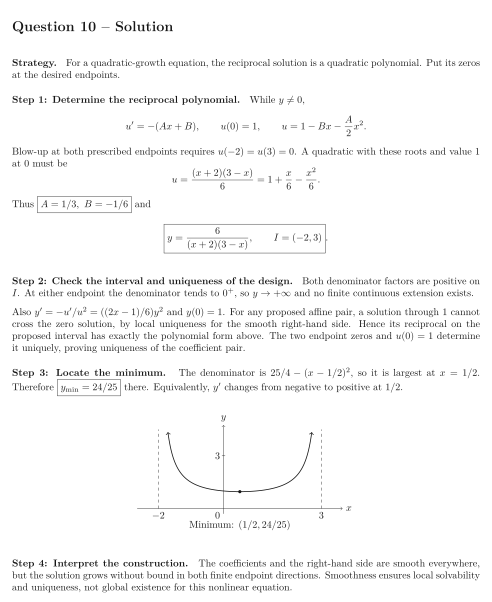
Design an initial-value problem of the form where are real constants, so that its solution has exactly the maximal interval and tends to at both finite endpoints.
Tasks
Use the reciprocal variable to determine and from the prescribed endpoints.
Recover the solution and prove that it is positive and has exactly the requested maximal interval.
Verify the IVP and prove that your coefficient pair is the only affine choice with these properties.
Find the solution’s minimum on its interval and sketch the curve with its endpoint asymptotes. Explain why smooth coefficients do not force a global solution here.
Show solutionHide solution
Question 10 – Solution
Strategy. For a quadratic-growth equation, the reciprocal solution is a quadratic polynomial. Put its zeros at the desired endpoints.
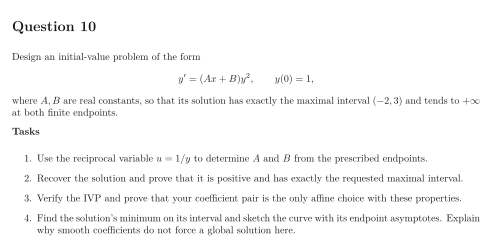
Step 1: Determine the reciprocal polynomial. While , Blow-up at both prescribed endpoints requires . A quadratic with these roots and value at must be Thus and
Step 2: Check the interval and uniqueness of the design. Both denominator factors are positive on . At either endpoint the denominator tends to , so and no finite continuous extension exists.
Also and . For any proposed affine pair, a solution through cannot cross the zero solution, by local uniqueness for the smooth right-hand side. Hence its reciprocal on the proposed interval has exactly the polynomial form above. The two endpoint zeros and determine it uniquely, proving uniqueness of the coefficient pair.
Step 3: Locate the minimum. The denominator is , so it is largest at . Therefore there. Equivalently, changes from negative to positive at .
See the diagram in the original worksheet below.
Step 4: Interpret the construction. The coefficients and the right-hand side are smooth everywhere, but the solution grows without bound in both finite endpoint directions. Smoothness ensures local solvability and uniqueness, not global existence for this nonlinear equation.