Question 2
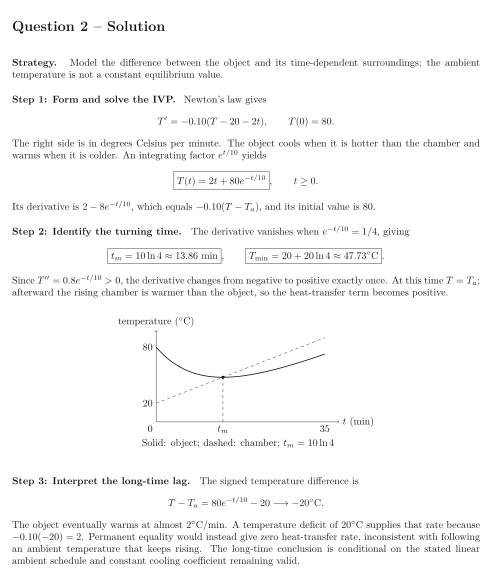
An object is placed in a controlled chamber. Its temperature is initially C, while the chamber temperature is degrees Celsius, with in minutes. Assume the object has a uniform temperature and obeys Newton’s law of cooling with constant coefficient min throughout the experiment. The chamber warming is prescribed and unaffected by the object.
Tasks
Formulate the temperature IVP, including the sign of the heat-transfer term.
Solve it and verify the initial temperature and differential equation.
Find when the object stops cooling and determine its minimum temperature. Explain how the object can subsequently warm under the same law.
Sketch the object and chamber temperatures. Find their limiting difference and explain why their temperatures do not become equal permanently.
Show solutionHide solution
Question 2 – Solution
Strategy. Model the difference between the object and its time-dependent surroundings; the ambient temperature is not a constant equilibrium value.
Step 1: Form and solve the IVP. Newton’s law gives The right side is in degrees Celsius per minute. The object cools when it is hotter than the chamber and warms when it is colder. An integrating factor yields Its derivative is , which equals , and its initial value is .
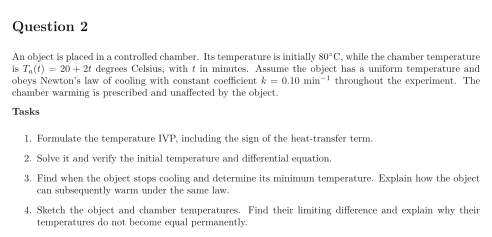
Step 2: Identify the turning time. The derivative vanishes when , giving Since , the derivative changes from negative to positive exactly once. At this time ; afterward the rising chamber is warmer than the object, so the heat-transfer term becomes positive.
See the diagram in the original worksheet below.
Step 3: Interpret the long-time lag. The signed temperature difference is The object eventually warms at almost C/min. A temperature deficit of C supplies that rate because . Permanent equality would instead give zero heat-transfer rate, inconsistent with following an ambient temperature that keeps rising. The long-time conclusion is conditional on the stated linear ambient schedule and constant cooling coefficient remaining valid.