Question 5
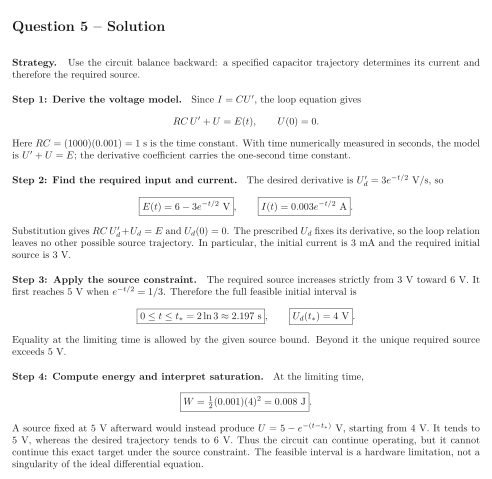
A series resistor-capacitor circuit has resistance and capacitance F. Its capacitor voltage is , charge is , and current is . The source voltage obeys the loop relation . Initially the capacitor is uncharged. Time is in seconds.
A designer wants the exact voltage trajectory but the available source must satisfy V. Ideal circuit laws are assumed; capacitor energy is .
Tasks
Derive a first-order IVP for the capacitor voltage and identify the time constant, with units.
Find the unique source voltage and the current required to produce the desired trajectory exactly.
Determine the longest interval starting at on which this trajectory respects the source bound. Find the capacitor voltage at the limiting time.
Calculate the stored energy at that time. Explain why simply fixing the source at V afterward cannot continue the same prescribed trajectory.
Show solutionHide solution
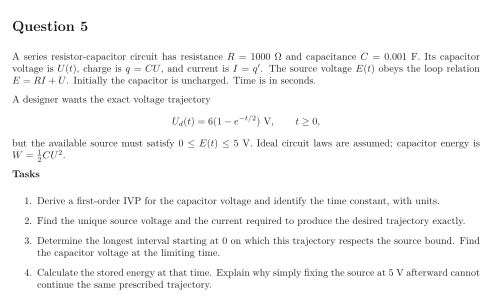
Question 5 – Solution
Strategy. Use the circuit balance backward: a specified capacitor trajectory determines its current and therefore the required source.
Step 1: Derive the voltage model. Since , the loop equation gives Here s is the time constant. With time numerically measured in seconds, the model is ; the derivative coefficient carries the one-second time constant.
Step 2: Find the required input and current. The desired derivative is V/s, so Substitution gives and . The prescribed fixes its derivative, so the loop relation leaves no other possible source trajectory. In particular, the initial current is mA and the required initial source is V.
Step 3: Apply the source constraint. The required source increases strictly from V toward V. It first reaches V when . Therefore the full feasible initial interval is Equality at the limiting time is allowed by the given source bound. Beyond it the unique required source exceeds V.
Step 4: Compute energy and interpret saturation. At the limiting time, A source fixed at V afterward would instead produce V, starting from V. It tends to V, whereas the desired trajectory tends to V. Thus the circuit can continue operating, but it cannot continue this exact target under the source constraint. The feasible interval is a hardware limitation, not a singularity of the ideal differential equation.