Question 6
An inverted conical tank has height m and top radius m. It initially contains water to the brim. Let be water depth above the outlet, with in seconds. Assume horizontal water surfaces and similar conical cross-sections. The outflow rate is prescribed by while . There is no inflow. Ignore changes in the discharge coefficient and stop outflow once the tank is empty.
Tasks
Derive the volume as a function of depth and use volume conservation to form an IVP for .
Solve for the depth until emptying and find the emptying time.
Find the fractions of the emptying time needed to reach half the original depth and half the original volume. Explain why these are different.
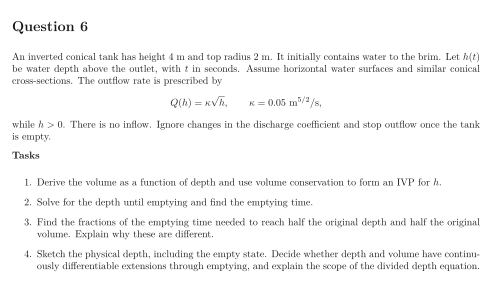
Sketch the physical depth, including the empty state. Decide whether depth and volume have continuously differentiable extensions through emptying, and explain the scope of the divided depth equation.
Show solutionHide solution
Question 6 – Solution
Strategy. The water surface area changes with depth. Convert a volume-loss law into a depth equation before separating variables.
Step 1: Use the conical geometry. Similarity gives , so and The first equality has units m/s. Division by is valid only while water remains.
Step 2: Integrate to emptying. Integrating gives , hence Equivalently, . Differentiation verifies the depth equation; the physical depth is set to zero for .
Step 3: Compare depth and volume targets. At m, , giving At half volume, , so Half depth leaves only one eighth of the original volume, so it takes substantially longer than losing half the volume.
See the diagram in the original worksheet below.
Step 4: Interpret the endpoint. As , , so the zero continuation of depth is continuous but not differentiable at emptying. However, , agreeing with afterward; volume has a continuously differentiable zero continuation. The divided depth equation is a wet-tank model and is undefined at . It must not be continued algebraically into a fictitious refilling branch.