Question 7
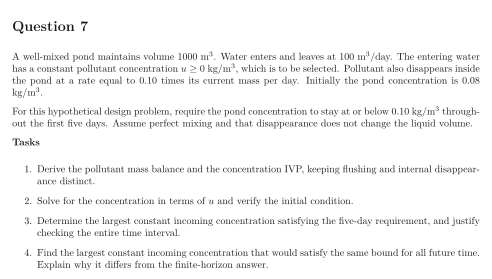
A well-mixed pond maintains volume m. Water enters and leaves at m/day. The entering water has a constant pollutant concentration kg/m, which is to be selected. Pollutant also disappears inside the pond at a rate equal to times its current mass per day. Initially the pond concentration is kg/m.
For this hypothetical design problem, require the pond concentration to stay at or below kg/m throughout the first five days. Assume perfect mixing and that disappearance does not change the liquid volume.
Tasks
Derive the pollutant mass balance and the concentration IVP, keeping flushing and internal disappearance distinct.
Solve for the concentration in terms of and verify the initial condition.
Determine the largest constant incoming concentration satisfying the five-day requirement, and justify checking the entire time interval.
Find the largest constant incoming concentration that would satisfy the same bound for all future time. Explain why it differs from the finite-horizon answer.
Show solutionHide solution
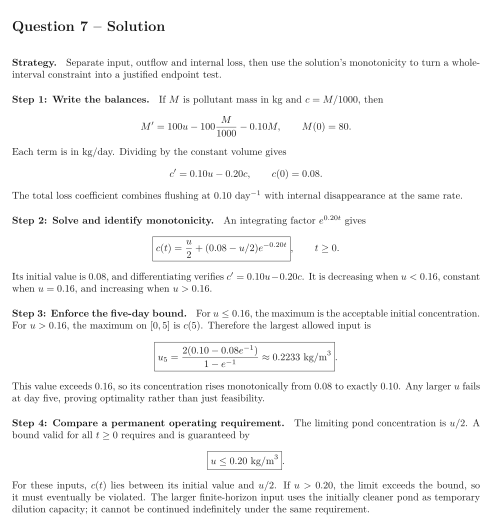
Question 7 – Solution
Strategy. Separate input, outflow and internal loss, then use the solution’s monotonicity to turn a whole-interval constraint into a justified endpoint test.
Step 1: Write the balances. If is pollutant mass in kg and , then Each term is in kg/day. Dividing by the constant volume gives The total loss coefficient combines flushing at day with internal disappearance at the same rate.
Step 2: Solve and identify monotonicity. An integrating factor gives Its initial value is , and differentiating verifies . It is decreasing when , constant when , and increasing when .
Step 3: Enforce the five-day bound. For , the maximum is the acceptable initial concentration. For , the maximum on is . Therefore the largest allowed input is This value exceeds , so its concentration rises monotonically from to exactly . Any larger fails at day five, proving optimality rather than just feasibility.
Step 4: Compare a permanent operating requirement. The limiting pond concentration is . A bound valid for all requires and is guaranteed by For these inputs, lies between its initial value and . If , the limit exceeds the bound, so it must eventually be violated. The larger finite-horizon input uses the initially cleaner pond as temporary dilution capacity; it cannot be continued indefinitely under the same requirement.