Question 2
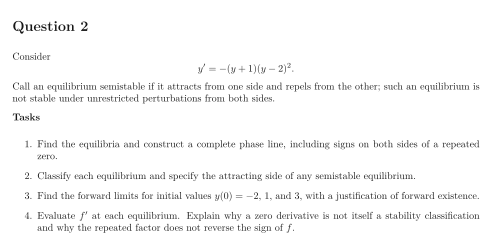
Consider Call an equilibrium semistable if it attracts from one side and repels from the other; such an equilibrium is not stable under unrestricted perturbations from both sides.
Tasks
Find the equilibria and construct a complete phase line, including signs on both sides of a repeated zero.
Classify each equilibrium and specify the attracting side of any semistable equilibrium.
Find the forward limits for initial values , , and , with a justification of forward existence.
Evaluate at each equilibrium. Explain why a zero derivative is not itself a stability classification and why the repeated factor does not reverse the sign of .
Show solutionHide solution
Question 2 – Solution
Strategy. Preserve the sign across a squared factor; use one-sided attraction and repulsion when the derivative test is inconclusive.
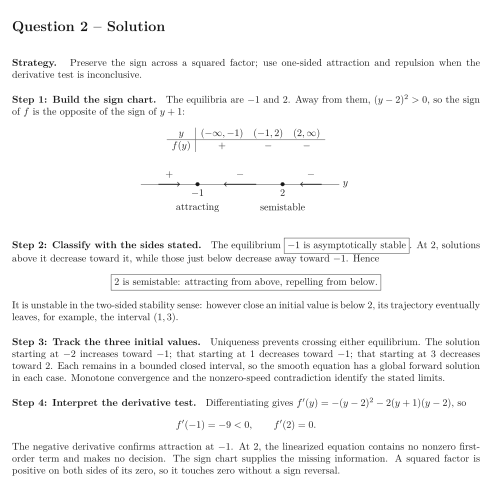
Step 1: Build the sign chart. The equilibria are and . Away from them, , so the sign of is the opposite of the sign of :
See the diagram in the original worksheet below.
Step 2: Classify with the sides stated. The equilibrium . At , solutions above it decrease toward it, while those just below decrease away toward . Hence It is unstable in the two-sided stability sense: however close an initial value is below , its trajectory eventually leaves, for example, the interval .
Step 3: Track the three initial values. Uniqueness prevents crossing either equilibrium. The solution starting at increases toward ; that starting at decreases toward ; that starting at decreases toward . Each remains in a bounded closed interval, so the smooth equation has a global forward solution in each case. Monotone convergence and the nonzero-speed contradiction identify the stated limits.
Step 4: Interpret the derivative test. Differentiating gives , so The negative derivative confirms attraction at . At , the linearized equation contains no nonzero first-order term and makes no decision. The sign chart supplies the missing information. A squared factor is positive on both sides of its zero, so it touches zero without a sign reversal.