Question 3
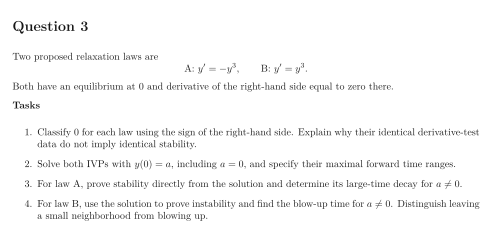
Two proposed relaxation laws are Both have an equilibrium at and derivative of the right-hand side equal to zero there.
Tasks
Classify for each law using the sign of the right-hand side. Explain why their identical derivative-test data do not imply identical stability.
Solve both IVPs with , including , and specify their maximal forward time ranges.
For law A, prove stability directly from the solution and determine its large-time decay for .
For law B, use the solution to prove instability and find the blow-up time for . Distinguish leaving a small neighborhood from blowing up.
Show solutionHide solution
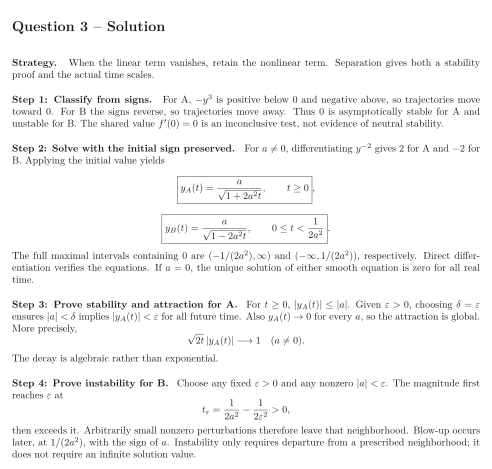
Question 3 – Solution
Strategy. When the linear term vanishes, retain the nonlinear term. Separation gives both a stability proof and the actual time scales.
Step 1: Classify from signs. For A, is positive below and negative above, so trajectories move toward . For B the signs reverse, so trajectories move away. Thus is asymptotically stable for A and unstable for B. The shared value is an inconclusive test, not evidence of neutral stability.
Step 2: Solve with the initial sign preserved. For , differentiating gives for A and for B. Applying the initial value yields The full maximal intervals containing are and , respectively. Direct differentiation verifies the equations. If , the unique solution of either smooth equation is zero for all real time.
Step 3: Prove stability and attraction for A. For , . Given , choosing ensures implies for all future time. Also for every , so the attraction is global. More precisely, The decay is algebraic rather than exponential.
Step 4: Prove instability for B. Choose any fixed and any nonzero . The magnitude first reaches at then exceeds it. Arbitrarily small nonzero perturbations therefore leave that neighborhood. Blow-up occurs later, at , with the sign of . Instability only requires departure from a prescribed neighborhood; it does not require an infinite solution value.