Question 8
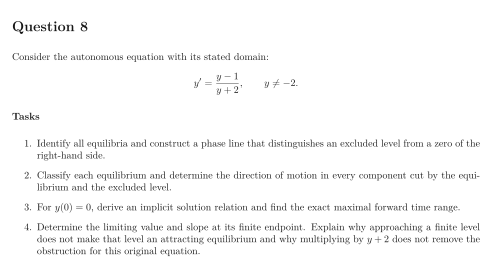
Consider the autonomous equation with its stated domain:
Tasks
Identify all equilibria and construct a phase line that distinguishes an excluded level from a zero of the right-hand side.
Classify each equilibrium and determine the direction of motion in every component cut by the equilibrium and the excluded level.
For , derive an implicit solution relation and find the exact maximal forward time range.
Determine the limiting value and slope at its finite endpoint. Explain why approaching a finite level does not make that level an attracting equilibrium and why multiplying by does not remove the obstruction for this original equation.
Show solutionHide solution
Question 8 – Solution
Strategy. A denominator zero splits the domain but is not an equilibrium. Test whether the selected trajectory reaches that boundary in finite time.
Step 1: Separate zeros from exclusions. The only equilibrium is . The value is outside the equation’s domain. The signs of are positive on , negative on , and positive on .
See the diagram in the original worksheet below.
Thus is unstable: arrows point away on both sides. Also , so confirms the classification.
Step 2: Integrate the selected branch. Starting at , the solution decreases within . Separation gives The constant is zero from . On , the derivative of the right side with respect to is . It is therefore invertible along this branch, and implicit differentiation verifies the original equation.
Step 3: Determine the endpoint. As , the time tends to This is the maximal forward range: the inverse exists until , but at its limiting value is excluded. Within the branch,
Step 4: Interpret the domain boundary. An attracting equilibrium must itself define a constant solution of the given equation. Here does not, and the selected solution reaches the boundary in finite time with unbounded slope rather than converging to a valid equilibrium as .
Multiplication gives , equivalent to the original only when . At it would demand for any finite derivative. Thus even the multiplied relation supplies no differentiable continuation through this boundary.
