Question 9
Let Think of as an energy function; no physical units are assumed.
Tasks
Derive the autonomous equation explicitly, find its equilibria, and classify them using the signs of the right-hand side.
Compute along a solution. Identify exactly when this derivative vanishes.
Sketch and relate its local minima and maximum to equilibrium stability. Explain why nonincreasing energy alone does not imply convergence to a global minimum for every initial value.
Determine the forward limit for every real initial value and justify global forward existence. State the basins of the attracting equilibria.
Show solutionHide solution
Question 9 – Solution
Strategy. Combine the energy identity with the phase line; energy decrease is informative but does not by itself choose a limiting equilibrium.
Step 1: Derive the flow and classify its zeros. Since , Its zeros are . Its signs on the successive intervals are , so and are asymptotically stable and is unstable.
Step 2: Differentiate the energy. The chain rule gives The derivative vanishes exactly at . On any nonconstant trajectory it is strictly negative, since uniqueness prevents meeting an equilibrium at a finite time.
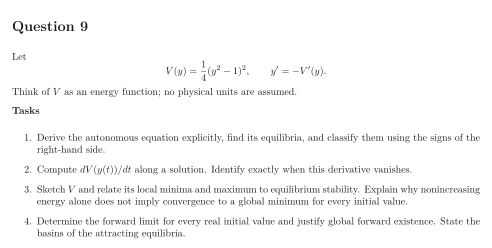
See the diagram in the original worksheet below.
Step 3: Interpret the energy landscape. The points are minima with ; is a local maximum with . Since the flow is down the energy gradient, the minima attract and the maximum repels. Nevertheless, the initial value stays at that maximum forever, with constant energy. Nonincreasing energy does not force every solution to reach a global minimum, nor distinguish which minimum will be selected.
Step 4: Determine the basins and future limits. The decreasing-energy bound confines a trajectory to , a bounded set because as . Smoothness then ensures global forward continuation. Phase-line trapping gives bounded monotonic motion for every nonconstant solution. Its limit must be a zero of , and it cannot cross zero. Therefore The basins are for and for .