Question 3
Consider a decaying quantity satisfying Apply explicit Euler with a constant step for arbitrarily many steps.
Tasks
Derive the numerical solution and determine exactly which steps give as .
Determine the stricter step condition that keeps every numerical value nonnegative and the sequence nonincreasing. Discuss and separately.
Compute enough values for and to show their contrasting behavior, and compare them graphically with the exact decay.
Explain why decreasing the physical solution’s magnitude does not by itself ensure decay of an Euler approximation, and distinguish stability from faithful positivity.
Show solutionHide solution
Question 3 – Solution
Strategy. Analyze the discrete amplification factor rather than transferring the differential equation’s stability directly to its numerical update.
Step 1: Solve the recurrence. The update is , so . It tends to zero exactly when
Step 2: Impose positivity and monotonicity. All values are nonnegative and nonincreasing exactly when , or At , the approximation becomes zero after one step, although is strictly positive at every finite time. At , oscillates without decay. For , its magnitude grows without bound.
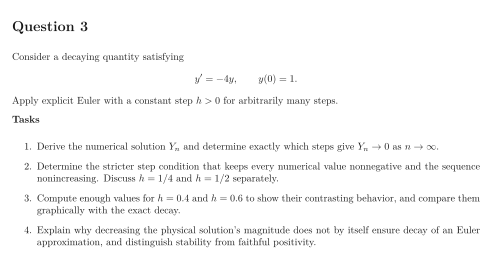
Step 3: Compare two oscillating sequences. Each row is plotted at its own times , not at common node indices interpreted as time.
See the diagram in the original worksheet below.
Step 4: Interpret numerical stability. The exact solution decays smoothly. Euler replaces its per-step factor by , which can be negative or have magnitude exceeding one. At the method is asymptotically decaying but produces unphysical sign changes; at it also loses decay. Stability controls long-run amplification, while positivity is an additional property with a stricter step requirement.