Question 5
A normalized population satisfies The exact solution preserves the physical interval . For explicit Euler with step , write . For the local discrete comparison, a small perturbation near is multiplied to first order by ; call the linearized update contracting when .
Tasks
Derive and find exactly which positive steps map all of back into .
Prove the condition is necessary, not merely sufficient, by producing an overshooting initial value whenever it fails.
Compute the first two Euler updates for , , and explain why they misrepresent the exact solution’s qualitative behavior.
Find the step range for linearized contraction at . Compare it with interval preservation, and sketch the update maps for and .
Show solutionHide solution
Question 5 – Solution
Strategy. Check the whole physical interval, not only the behavior of tiny perturbations near its upper endpoint.
Step 1: Factor the interval constraint. Euler gives . On it is nonnegative. Also If , both factors are nonnegative for every , so . Therefore preserves the interval at every step by induction.
Step 2: Prove necessity. If , choose strictly between and . Then but , so . Such a value exists for every , proving the stated condition is exact.
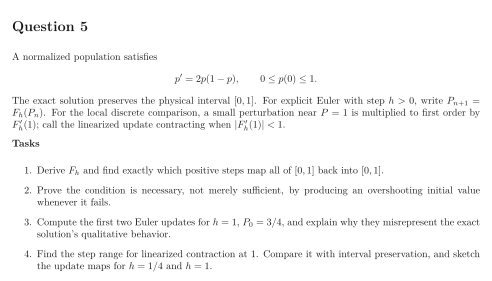
Step 3: Exhibit overshoot. For , , giving The numerical solution crosses above the capacity and then drops. The exact solution starting at increases toward from below and cannot cross that equilibrium, by uniqueness.
See the diagram in the original worksheet below.
Step 4: Distinguish two step restrictions. Since , . Linearized contraction therefore holds for , a larger range than interval preservation. At the linearized magnitude equals one, so the strict contraction test makes no decision about nonlinear asymptotic behavior.
A locally contracting update can still move some valid states above the physical bound. The map criterion protects the entire interval; the derivative criterion only describes first-order behavior near one fixed point.