Question 9
Consider the nonlinear equation For a real parameter , define A classical solution here means a real function satisfying the equation at every point of its interval.
Tasks
Verify the equation on each open side of .
Check the value, first derivative and second derivative at the joining point. Does the equation hold there as well?
Verify both initial conditions for every , and show that different finite choices of give different solutions. Identify one additional solution.
Sketch , and the zero solution on . Explain why continuity of the right-hand side does not justify applying the linear initial-value uniqueness theorem to this example. Does an assigned position and slope always determine a unique trajectory?
Show solutionHide solution
Question 9 – Solution
Strategy. Verify the join at the derivative order required by the equation, then use the family as a counterexample to an overgeneralized uniqueness claim.
Step 1: Verify away from the join. For , both sides of the equation are zero. For , The coefficient 144 is essential to this identity.
Step 2: Verify classical regularity at the join. The right-hand limits of as are all zero, matching the values on the left. The first and second derivatives at the join are also zero, as follows directly from their difference quotients. Hence is on .
At , the equation reads , so it holds there, not merely away from the join. There is no hidden corner in position or velocity.
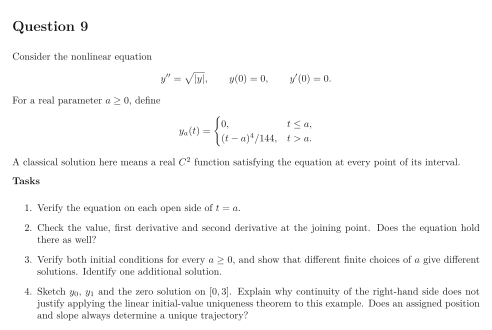
Step 3: Check the common data and distinctness. Since , every family member has , including by the join calculation. If , choose . Then but , proving they are different solutions. The function is another solution, different from every finite-delay member.
See the diagram in the original worksheet below.
Step 4: State exactly what has failed. The right-hand side is continuous but depends nonlinearly on the unknown function. This is not an equation with prescribed continuous coefficients, so that linear theorem cannot be invoked. The verified family proves that continuity alone does not ensure uniqueness for a general nonlinear second-order equation.
Two initial data determine one solution under appropriate hypotheses, not for every differential equation. This example exhibits infinitely many solutions; it does not claim to classify all solutions of the nonlinear equation.