Question 9
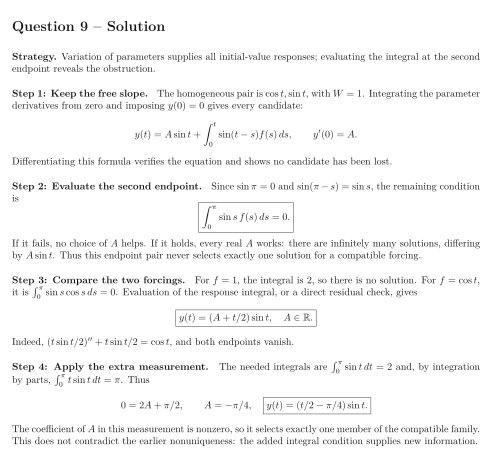
Let be continuous on . Seek solutions of Use variation of parameters; no general boundary-value theory is required.
Tasks
Write every solution satisfying the first endpoint condition, using its free initial slope .
Derive a necessary and sufficient condition on for the second endpoint condition. Explain uniqueness or nonuniqueness when the condition holds.
Apply the criterion to and , and find all solutions in the latter case.
For , impose the additional condition . Determine whether it selects a unique solution and find it.
Show solutionHide solution
Question 9 – Solution
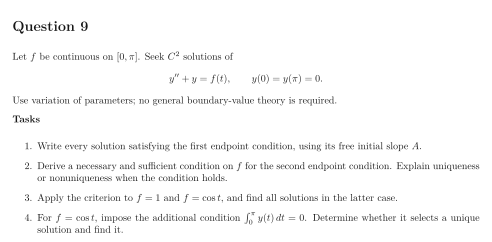
Strategy. Variation of parameters supplies all initial-value responses; evaluating the integral at the second endpoint reveals the obstruction.
Step 1: Keep the free slope. The homogeneous pair is , with . Integrating the parameter derivatives from zero and imposing gives every candidate: Differentiating this formula verifies the equation and shows no candidate has been lost.
Step 2: Evaluate the second endpoint. Since and , the remaining condition is If it fails, no choice of helps. If it holds, every real works: there are infinitely many solutions, differing by . Thus this endpoint pair never selects exactly one solution for a compatible forcing.
Step 3: Compare the two forcings. For , the integral is , so there is no solution. For , it is . Evaluation of the response integral, or a direct residual check, gives Indeed, , and both endpoints vanish.
Step 4: Apply the extra measurement. The needed integrals are and, by integration by parts, . Thus The coefficient of in this measurement is nonzero, so it selects exactly one member of the compatible family. This does not contradict the earlier nonuniqueness: the added integral condition supplies new information.