Question 3
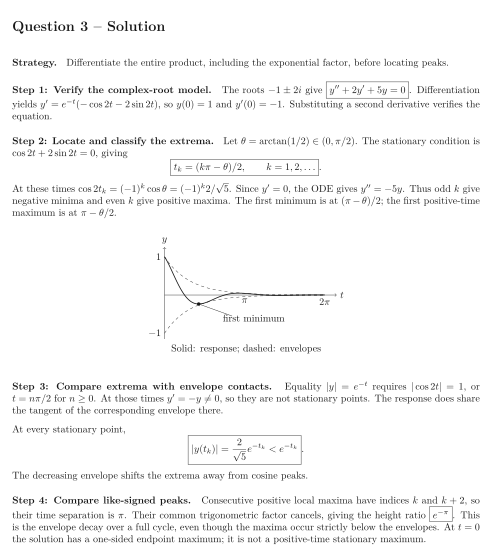
For the response on , the curves are called its exponential envelopes because .
Tasks
Find a monic homogeneous equation with this solution and verify its initial value and slope.
Find all positive-time stationary points, classify them, and identify the first minimum and the first positive-time maximum.
Determine where the response touches an envelope. Are these times stationary points? Find the ratio of each stationary-point magnitude to the envelope height there.
Sketch the response and envelopes on , marking the first minimum. Determine the ratio of consecutive positive local maxima and explain why envelope contacts and extrema must be distinguished.
Show solutionHide solution
Question 3 – Solution
Strategy. Differentiate the entire product, including the exponential factor, before locating peaks.
Step 1: Verify the complex-root model. The roots give . Differentiation yields , so and . Substituting a second derivative verifies the equation.
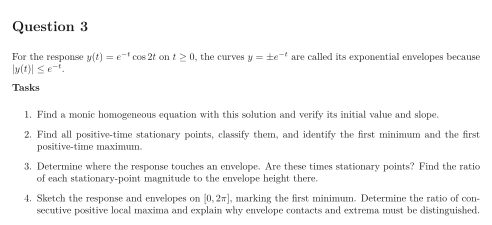
Step 2: Locate and classify the extrema. Let . The stationary condition is , giving At these times . Since , the ODE gives . Thus odd give negative minima and even give positive maxima. The first minimum is at ; the first positive-time maximum is at .
See the diagram in the original worksheet below.
Step 3: Compare extrema with envelope contacts. Equality requires , or for . At those times , so they are not stationary points. The response does share the tangent of the corresponding envelope there.
At every stationary point, The decreasing envelope shifts the extrema away from cosine peaks.
Step 4: Compare like-signed peaks. Consecutive positive local maxima have indices and , so their time separation is . Their common trigonometric factor cancels, giving the height ratio . This is the envelope decay over a full cycle, even though the maxima occur strictly below the envelopes. At the solution has a one-sided endpoint maximum; it is not a positive-time stationary maximum.