Question 4
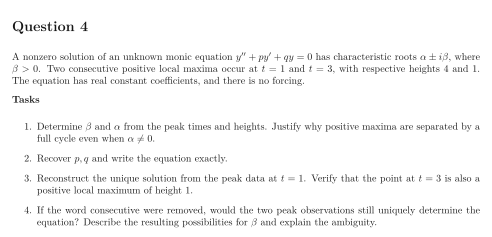
A nonzero solution of an unknown monic equation has characteristic roots , where . Two consecutive positive local maxima occur at and , with respective heights 4 and 1. The equation has real constant coefficients, and there is no forcing.
Tasks
Determine and from the peak times and heights. Justify why positive maxima are separated by a full cycle even when .
Recover and write the equation exactly.
Reconstruct the unique solution from the peak data at . Verify that the point at is also a positive local maximum of height 1.
If the word consecutive were removed, would the two peak observations still uniquely determine the equation? Describe the resulting possibilities for and explain the ambiguity.
Show solutionHide solution
Question 4 – Solution
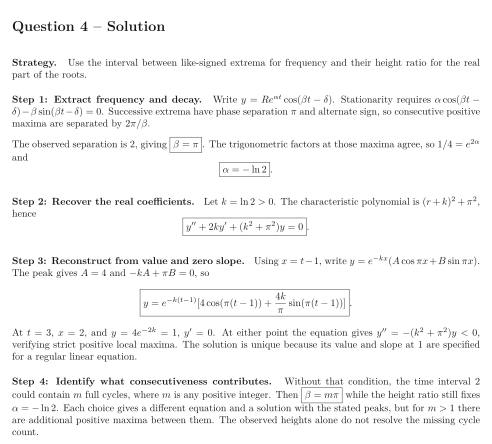
Strategy. Use the interval between like-signed extrema for frequency and their height ratio for the real part of the roots.
Step 1: Extract frequency and decay. Write . Stationarity requires . Successive extrema have phase separation and alternate sign, so consecutive positive maxima are separated by .
The observed separation is 2, giving . The trigonometric factors at those maxima agree, so and
Step 2: Recover the real coefficients. Let . The characteristic polynomial is , hence
Step 3: Reconstruct from value and zero slope. Using , write . The peak gives and , so At , , and , . At either point the equation gives , verifying strict positive local maxima. The solution is unique because its value and slope at 1 are specified for a regular linear equation.
Step 4: Identify what consecutiveness contributes. Without that condition, the time interval 2 could contain full cycles, where is any positive integer. Then while the height ratio still fixes . Each choice gives a different equation and a solution with the stated peaks, but for there are additional positive maxima between them. The observed heights alone do not resolve the missing cycle count.