Question 7
An unknown frequency appears in Exact observations at all nonnegative integer times report .
Tasks
Solve the IVP in terms of and determine every frequency compatible with the integer observations.
Explain why the observations, even with the known initial slope, do not imply the zero solution and do not identify a unique frequency.
An additional exact observation gives . Determine which of the previously possible frequencies remain. Prove that no larger candidate frequency can fit it.
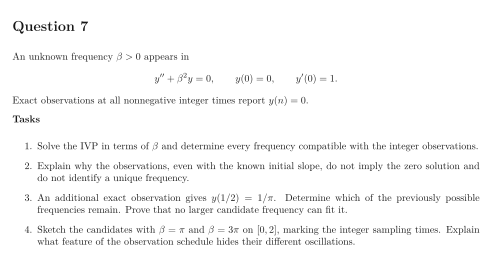
Sketch the candidates with and on , marking the integer sampling times. Explain what feature of the observation schedule hides their different oscillations.
Show solutionHide solution
Question 7 – Solution
Strategy. Solve before interpreting the data; a sampling grid can repeatedly land on zeros of a nonzero oscillation.
Step 1: Determine all admissible frequencies. The roots are , and the data give In particular, implies , so for a positive integer . Conversely, each such frequency makes every integer observation zero. The complete candidate set is therefore
Step 2: Retain the slope information correctly. Each candidate has and hence , so each is nonzero. The zero function would violate that slope. The slope sets the sine coefficient to , but still allows infinitely many frequencies. A known initial slope does not rescue a schedule that misses all intermediate oscillations.
Step 3: Use the extra observation to select a frequency. For the candidate indexed by , For this equals . For every , its absolute value is at most , making agreement impossible. Thus the new datum selects exactly and .
See the diagram in the original worksheet below.
Step 4: Explain the indistinguishable samples. The integer grid samples an integer number of half-cycles for every candidate, so it always observes a zero. The two plotted curves differ between those times, including in amplitude, yet share all grid values and the initial slope. This is an explicit sampling ambiguity, not a violation of uniqueness: each fixed equation has one solution for its data, while different frequencies define different equations.