Question 8
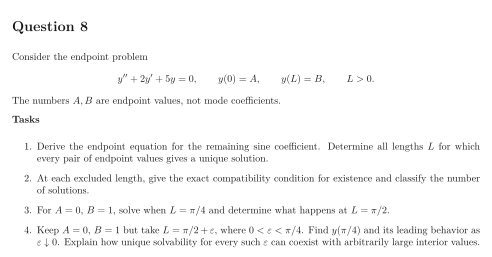
Consider the endpoint problem The numbers are endpoint values, not mode coefficients.
Tasks
Derive the endpoint equation for the remaining sine coefficient. Determine all lengths for which every pair of endpoint values gives a unique solution.
At each excluded length, give the exact compatibility condition for existence and classify the number of solutions.
For , , solve when and determine what happens at .
Keep , but take , where . Find and its leading behavior as . Explain how unique solvability for every such can coexist with arbitrarily large interior values.
Show solutionHide solution
Question 8 – Solution
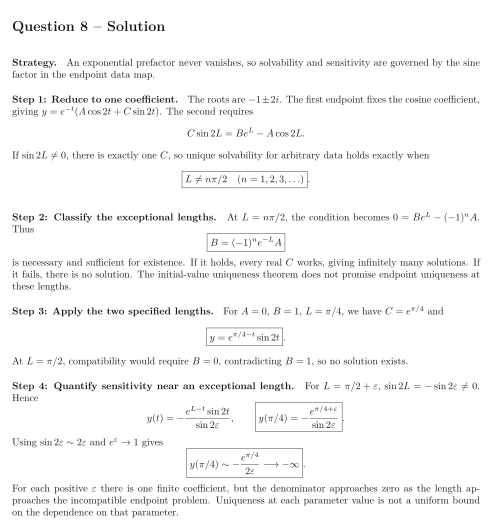
Strategy. An exponential prefactor never vanishes, so solvability and sensitivity are governed by the sine factor in the endpoint data map.
Step 1: Reduce to one coefficient. The roots are . The first endpoint fixes the cosine coefficient, giving . The second requires If , there is exactly one , so unique solvability for arbitrary data holds exactly when
Step 2: Classify the exceptional lengths. At , the condition becomes . Thus is necessary and sufficient for existence. If it holds, every real works, giving infinitely many solutions. If it fails, there is no solution. The initial-value uniqueness theorem does not promise endpoint uniqueness at these lengths.
Step 3: Apply the two specified lengths. For , , , we have and At , compatibility would require , contradicting , so no solution exists.
Step 4: Quantify sensitivity near an exceptional length. For , . Hence Using and gives For each positive there is one finite coefficient, but the denominator approaches zero as the length approaches the incompatible endpoint problem. Uniqueness at each parameter value is not a uniform bound on the dependence on that parameter.