Question 9
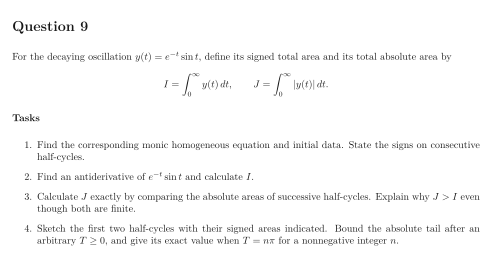
For the decaying oscillation , define its signed total area and its total absolute area by
Tasks
Find the corresponding monic homogeneous equation and initial data. State the signs on consecutive half-cycles.
Find an antiderivative of and calculate .
Calculate exactly by comparing the absolute areas of successive half-cycles. Explain why even though both are finite.
Sketch the first two half-cycles with their signed areas indicated. Bound the absolute tail after an arbitrary , and give its exact value when for a nonnegative integer .
Show solutionHide solution
Question 9 – Solution
Strategy. Separate cancellation between lobes from decay of each lobe, then sum the absolute areas as a geometric series.
Step 1: Identify the equation and signs. The roots are , so . The derivative is , giving , . On , the sign is : positive first, negative next, and alternating thereafter.
Step 2: Integrate the signed response. Integration by parts twice, or differentiation of the result, gives Since as and ,
Step 3: Sum the magnitudes without cancellation. The first positive lobe has area The substitution shows that the absolute area of the th lobe is . Thus the convergent geometric sum gives The negative lobes reduce but contribute positively to . Infinitely many oscillations do not prevent absolute convergence because the lobe magnitudes decrease geometrically.
See the diagram in the original worksheet below.
Step 4: Control the unobserved tail. Since , At a half-cycle boundary, substitution by preserves , so the exact absolute tail is . The signed area of the second plotted lobe is , while its contribution to is .
