Question 10
Consider A settling certificate at time means a proof that for every . Distinguish a certificate for this specific solution from one valid for every phase with the same trigonometric amplitude.
Tasks
Find the solution, its amplitude , and its phase in the form .
Use the envelope to find the smallest certificate time valid for every phase with amplitude . Prove the claimed optimality over phases.
For the stated IVP, show that is already a certificate. Use the value at 1.9 and the magnitudes of all later stationary points, justifying their ordering. Numerical evaluations should be supported by exact expressions.
Sketch the response for with the tolerance levels and envelope certificate marked. Explain why the envelope certificate need not be the earliest settling time for one fixed phase, and whether Task 3 identifies that exact earliest time.
Show solutionHide solution
Question 10 – Solution
Strategy. First obtain a phase-independent bound, then sharpen it for one solution by controlling every later extremum.
Step 1: Resolve the data and phase. The roots are . Writing gives and , hence . Thus
Step 2: Obtain the best certificate for every phase. The envelope condition is , so It guarantees the tolerance at every later time. For any proposed , choose a phase with an integer multiple of . That solution has . Thus no earlier time works for every phase with amplitude 5.
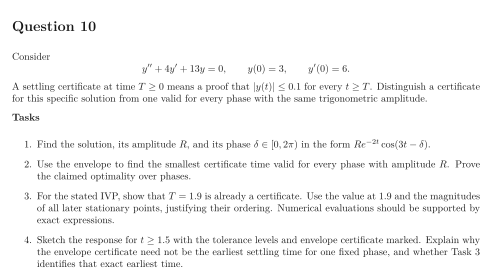
Step 3: Check the fixed phase more sharply. Let . Stationary times are , and their magnitudes are . In particular, Also . Between 1.9 and there is no stationary point, so the response is monotone and its absolute value is bounded by the larger endpoint magnitude. Each subsequent stationary magnitude is multiplied by . Monotonicity between those extrema then proves .
See the diagram in the original worksheet below.
Step 4: Distinguish a certificate from the exact last crossing. The envelope treats all phases, whereas the specified phase can have small values while the envelope is still above 0.1. The preceding negative minimum has magnitude greater than 0.1, so a final tolerance crossing occurs between and 1.9. Task 3 proves a sufficient time, not that 1.9 is the earliest one; locating the exact last crossing requires solving the corresponding trigonometric-exponential level equation.