Question 6
The repeated-root response solves with , . Consider exponential bounds on .
Tasks
Find the maximum of and verify that it tends to zero.
Determine whether any finite constant can satisfy for every .
For a fixed , find the smallest such that for every . Prove optimality and sketch the bound for with its contact point.
Extend the argument to by giving an explicit finite bound with rate . Explain why eventual decay does not automatically give a bound with the exact exponent 1.
Show solutionHide solution
Question 6 – Solution
Strategy. Divide by the proposed exponential bound and maximize the resulting ratio, rather than judging only the root’s sign.
Step 1: Find the transient peak. We have , so the response rises until and falls thereafter. Hence Also , for example by l’Hôpital’s rule, proving eventual decay.
Step 2: Test the exact root exponent. The proposed bound is equivalent to for all , which no finite can satisfy. The exponential decay is modified by an unbounded polynomial prefactor.
Step 3: Find the sharp slightly slower bound. Dividing by gives the ratio . Its derivative is , so its unique maximum occurs at and equals . Thus This constant is sufficient by the maximum calculation and necessary because equality holds at that time.
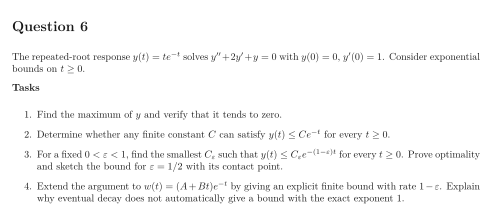
See the diagram in the original worksheet below.
For , the bound is and contact occurs at , where both values are . Both derivatives equal , confirming tangency rather than a crossing.
Step 4: Bound every fixed repeated-root solution. The triangle inequality gives Therefore . This displayed constant need not be optimal for arbitrary . A bound with the exact exponent 1 exists precisely when ; for , the ratio is unbounded even though itself decays.