Question 7
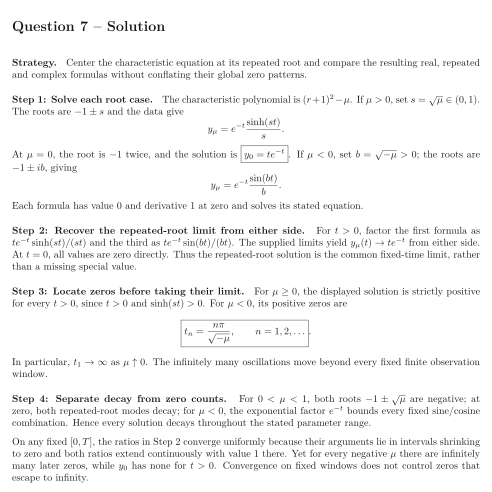
Consider the parameter family For convenience, . You may use and as .
Tasks
Solve the IVP separately for , and , identifying the root type in each case.
Prove that the formulas from both sides tend to the repeated-root solution for each fixed as .
Determine which of these solutions have positive-time zeros. For , find the first positive zero and its limit as .
Prove that every solution of every equation in the stated parameter range tends to zero as . Explain why convergence of the displayed IVP solutions on any fixed time window does not preserve their number of positive-time zeros.
Show solutionHide solution
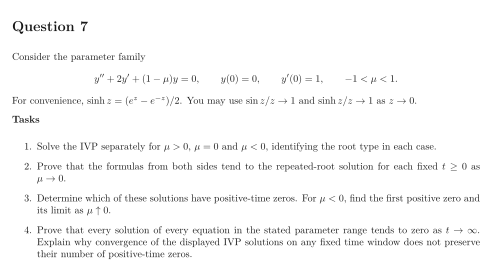
Question 7 – Solution
Strategy. Center the characteristic equation at its repeated root and compare the resulting real, repeated and complex formulas without conflating their global zero patterns.
Step 1: Solve each root case. The characteristic polynomial is . If , set . The roots are and the data give At , the root is twice, and the solution is . If , set ; the roots are , giving Each formula has value 0 and derivative 1 at zero and solves its stated equation.
Step 2: Recover the repeated-root limit from either side. For , factor the first formula as and the third as . The supplied limits yield from either side. At , all values are zero directly. Thus the repeated-root solution is the common fixed-time limit, rather than a missing special value.
Step 3: Locate zeros before taking their limit. For , the displayed solution is strictly positive for every , since and . For , its positive zeros are In particular, as . The infinitely many oscillations move beyond every fixed finite observation window.
Step 4: Separate decay from zero counts. For , both roots are negative; at zero, both repeated-root modes decay; for , the exponential factor bounds every fixed sine/cosine combination. Hence every solution decays throughout the stated parameter range.
On any fixed , the ratios in Step 2 converge uniformly because their arguments lie in intervals shrinking to zero and both ratios extend continuously with value 1 there. Yet for every negative there are infinitely many later zeros, while has none for . Convergence on fixed windows does not control zeros that escape to infinity.