Question 9
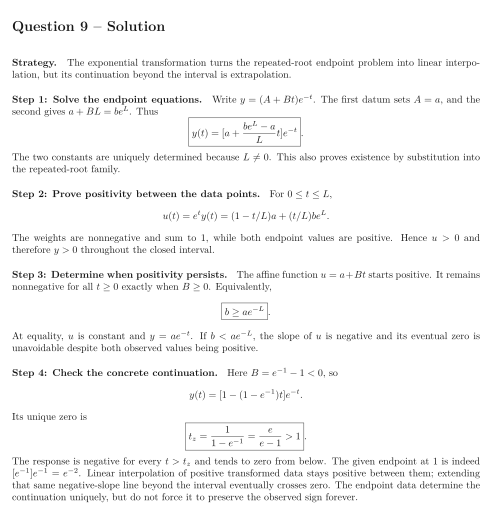
For and strictly positive endpoint values , consider The same solution is defined beyond the observed interval.
Tasks
Find the unique solution and justify uniqueness for every .
Prove that it is strictly positive throughout using the transformed quantity .
Determine exactly which endpoint pairs make the response nonnegative for every future time , not just between observations.
For , , , find the first zero after the observed interval and determine the sign for all later times. Explain why positive endpoint observations did not guarantee permanent positivity.
Show solutionHide solution
Question 9 – Solution
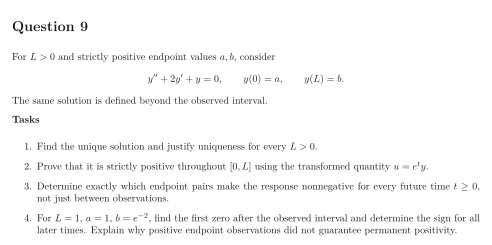
Strategy. The exponential transformation turns the repeated-root endpoint problem into linear interpolation, but its continuation beyond the interval is extrapolation.
Step 1: Solve the endpoint equations. Write . The first datum sets , and the second gives . Thus The two constants are uniquely determined because . This also proves existence by substitution into the repeated-root family.
Step 2: Prove positivity between the data points. For , The weights are nonnegative and sum to 1, while both endpoint values are positive. Hence and therefore throughout the closed interval.
Step 3: Determine when positivity persists. The affine function starts positive. It remains nonnegative for all exactly when . Equivalently, At equality, is constant and . If , the slope of is negative and its eventual zero is unavoidable despite both observed values being positive.
Step 4: Check the concrete continuation. Here , so Its unique zero is The response is negative for every and tends to zero from below. The given endpoint at 1 is indeed . Linear interpolation of positive transformed data stays positive between them; extending that same negative-slope line beyond the interval eventually crosses zero. The endpoint data determine the continuation uniquely, but do not force it to preserve the observed sign forever.