Question 1
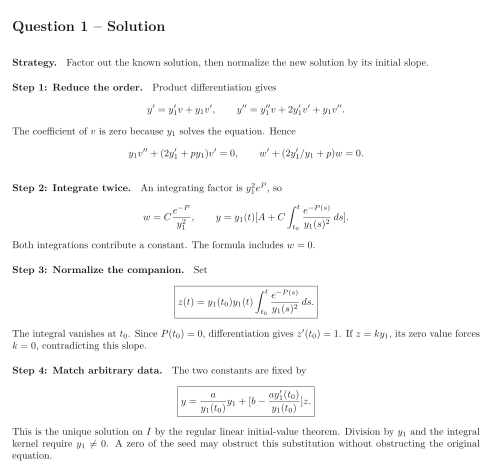
Let be continuous on an open interval , let , and let be a known solution of that never vanishes on . Write .
Tasks
Derive the equation for after substituting .
Solve the first-order equation for and give an integral formula for .
Construct a solution with and . Prove that is not a constant multiple of .
Express the solution with , in terms of . Explain why the nonvanishing hypothesis matters.
Show solutionHide solution
Question 1 – Solution
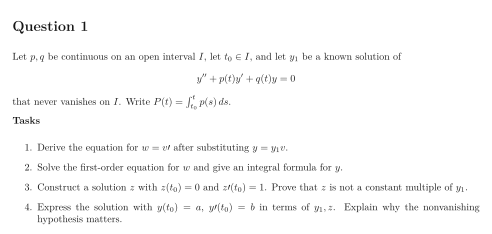
Strategy. Factor out the known solution, then normalize the new solution by its initial slope.
Step 1: Reduce the order. Product differentiation gives The coefficient of is zero because solves the equation. Hence
Step 2: Integrate twice. An integrating factor is , so Both integrations contribute a constant. The formula includes .
Step 3: Normalize the companion. Set The integral vanishes at . Since , differentiation gives . If , its zero value forces , contradicting this slope.
Step 4: Match arbitrary data. The two constants are fixed by This is the unique solution on by the regular linear initial-value theorem. Division by and the integral kernel require . A zero of the seed may obstruct this substitution without obstructing the original equation.