Question 2
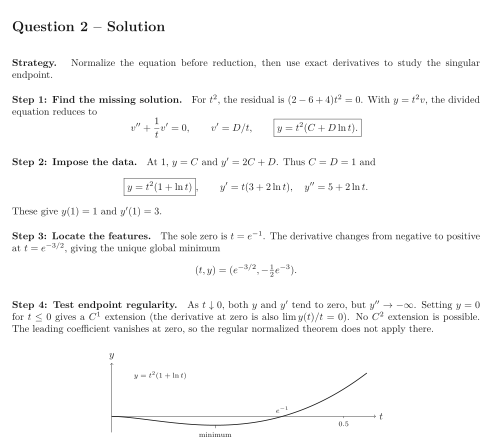
On , consider A proposed known solution is .
Tasks
Verify and use reduction of order to find the general solution.
Solve the initial-value problem and verify both data.
Find every zero and stationary point of this solution on , and classify the stationary point.
Determine whether this solution has a extension and whether it has a extension through . Justify using one-sided limits.
Show solutionHide solution
Question 2 – Solution
Strategy. Normalize the equation before reduction, then use exact derivatives to study the singular endpoint.
Step 1: Find the missing solution. For , the residual is . With , the divided equation reduces to
Step 2: Impose the data. At , and . Thus and These give and .
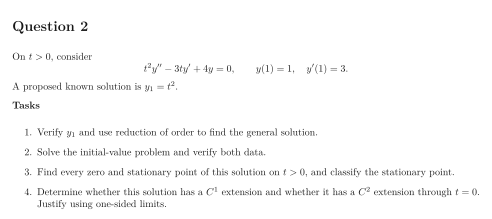
Step 3: Locate the features. The sole zero is . The derivative changes from negative to positive at , giving the unique global minimum
Step 4: Test endpoint regularity. As , both and tend to zero, but . Setting for gives a extension (the derivative at zero is also ). No extension is possible. The leading coefficient vanishes at zero, so the regular normalized theorem does not apply there.
See the diagram in the original worksheet below.