Question 5
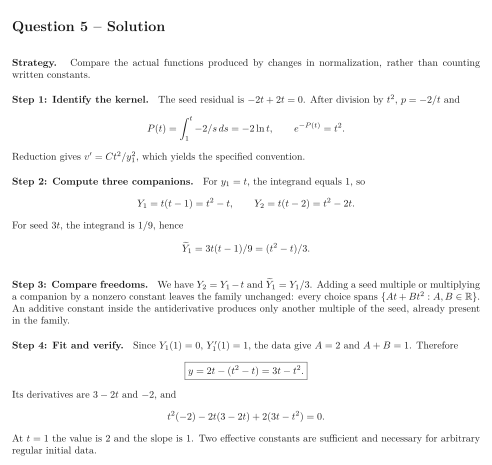
On , consider with seed . Use the following unnormalized companion convention: The numerator is held fixed when changing or rescaling the seed.
Tasks
Verify the seed and derive the kernel in this convention from the normalized equation.
Compute , , and the companion obtained with seed and lower limit .
Explain why these choices give the same solution space. Why does an arbitrary additive integration constant not create a third solution freedom?
Use to solve , . Verify the equation and data.
Show solutionHide solution
Question 5 – Solution
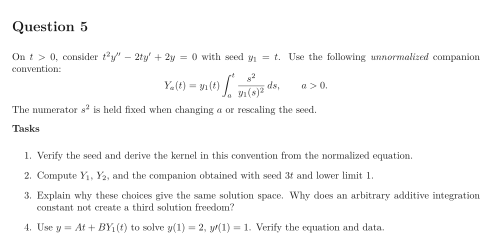
Strategy. Compare the actual functions produced by changes in normalization, rather than counting written constants.
Step 1: Identify the kernel. The seed residual is . After division by , and Reduction gives , which yields the specified convention.
Step 2: Compute three companions. For , the integrand equals , so For seed , the integrand is , hence
Step 3: Compare freedoms. We have and . Adding a seed multiple or multiplying a companion by a nonzero constant leaves the family unchanged: every choice spans . An additive constant inside the antiderivative produces only another multiple of the seed, already present in the family.
Step 4: Fit and verify. Since , , the data give and . Therefore Its derivatives are and , and At the value is and the slope is . Two effective constants are sufficient and necessary for arbitrary regular initial data.