Question 6
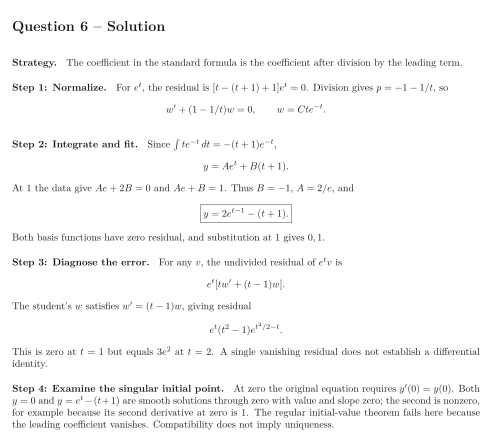
On , consider A student inserts the undivided coefficient into the usual normalized reduction formula and obtains .
Tasks
Verify the seed, normalize the equation, and derive the correct equation for .
Find the full solution family and solve , .
Compute the residual of the student’s candidate , with . Explain why testing only would miss the error.
For the original undivided equation at , find the necessary relation between value and slope. Exhibit two distinct smooth solutions with zero value and slope there.
Show solutionHide solution
Question 6 – Solution
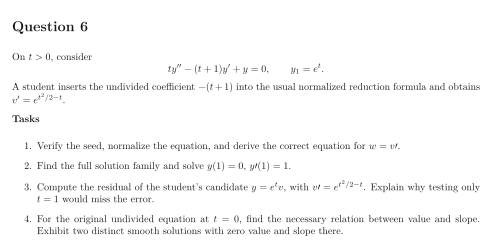
Strategy. The coefficient in the standard formula is the coefficient after division by the leading term.
Step 1: Normalize. For , the residual is . Division gives , so
Step 2: Integrate and fit. Since , At the data give and . Thus , , and Both basis functions have zero residual, and substitution at gives .
Step 3: Diagnose the error. For any , the undivided residual of is The student’s satisfies , giving residual This is zero at but equals at . A single vanishing residual does not establish a differential identity.
Step 4: Examine the singular initial point. At zero the original equation requires . Both and are smooth solutions through zero with value and slope zero; the second is nonzero, for example because its second derivative at zero is . The regular initial-value theorem fails here because the leading coefficient vanishes. Compatibility does not imply uniqueness.