Question 1
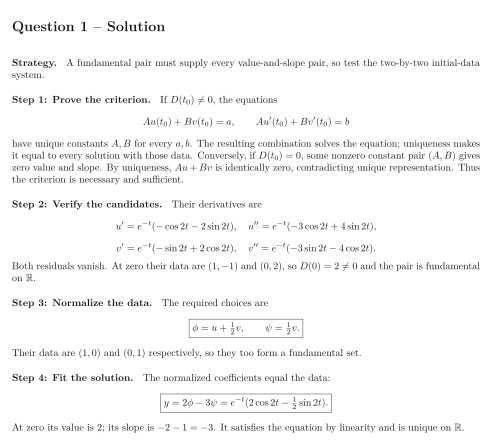
A fundamental set for a homogeneous linear equation on an interval is a pair of solutions whose constant linear combinations represent every solution uniquely. Let be continuous on an open interval . For two solutions of , define
Tasks
Using existence and uniqueness for initial data, prove that the pair is fundamental on if and only if .
For on , verify , and apply the criterion at zero.
Construct solutions with initial data and .
Use this normalized pair to solve , , and verify the data.
Show solutionHide solution
Question 1 – Solution
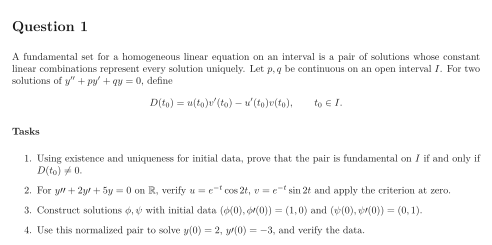
Strategy. A fundamental pair must supply every value-and-slope pair, so test the two-by-two initial-data system.
Step 1: Prove the criterion. If , the equations have unique constants for every . The resulting combination solves the equation; uniqueness makes it equal to every solution with those data. Conversely, if , some nonzero constant pair gives zero value and slope. By uniqueness, is identically zero, contradicting unique representation. Thus the criterion is necessary and sufficient.
Step 2: Verify the candidates. Their derivatives are Both residuals vanish. At zero their data are and , so and the pair is fundamental on .
Step 3: Normalize the data. The required choices are Their data are and respectively, so they too form a fundamental set.
Step 4: Fit the solution. The normalized coefficients equal the data: At zero its value is ; its slope is . It satisfies the equation by linearity and is unique on .