Question 2
For the equation on , consider the parameter-dependent pair Coefficients in a fundamental set must be constant in .
Tasks
Verify both solutions and find all for which the pair is fundamental.
For those parameters, find the coefficients of the solution with , in this pair.
As , compare the behavior of these coefficients with the behavior of the represented solution. Can large coefficients alone establish large solution values?
Construct from a companion with data that extends to a well-defined function at . Explain why simply setting in the original pair fails.
Show solutionHide solution
Question 2 – Solution
Strategy. Track the initial-data vectors as the two proposed basis elements approach dependence.
Step 1: Test independence. Each exponential solves , so both combinations do. The data vectors at zero are and , with determinant . The pair is fundamental exactly when . At , both functions equal .
Step 2: Fit the data. In , the data require Thus
Step 3: Simplify before taking a limit. Substitution cancels the large terms exactly: Both coefficients grow without bound in magnitude near , while the function is independent of . Large coordinates in a nearly dependent pair do not imply large values of the function on a fixed interval.
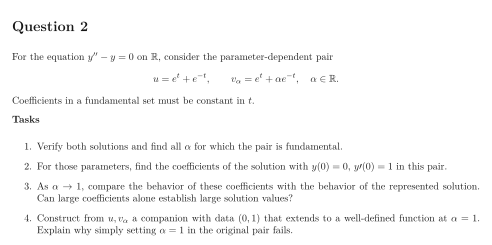
Step 4: Replace the collapsing direction. Define, for , This extends by and has data . The pair remains fundamental. The original pair at contains only one effective direction and cannot supply the requested nonzero slope.
See the diagram in the original worksheet below.