Question 4
The smooth functions and are proposed as a fundamental set for an equation with continuous coefficients on .
Tasks
Prove that are linearly independent as functions on .
Prove that no such regular normalized equation on can have both as solutions. Explain why independence alone is insufficient.
Find the normalized equation having both as solutions on and verify that they form a fundamental set there.
On , solve , using the pair. Explain why its zero value and slope at zero do not contradict your conclusion about regular equations.
Show solutionHide solution
Question 4 – Solution
Strategy. Check both requirements: independence and membership in the solution space of one regular equation on the stated interval.
Step 1: Prove independence. If for every real , then for every nonzero . Evaluating at two distinct nonzero points forces .
Step 2: Reject the proposed regular equation. The nonzero function has . Uniqueness for continuous normalized coefficients would force it to equal the zero solution on . Equivalently, substitution at zero would require . Thus these independent functions cannot be a fundamental set for any equation of the stated kind.
Step 3: Work on a valid interval. Substituting the two functions for gives Subtracting times the first equation from the second yields , then . Hence Both residuals vanish, the coefficients are continuous on , and there, so the pair is fundamental.
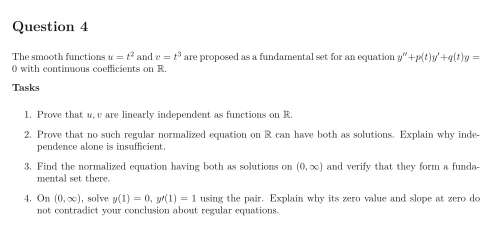
Step 4: Fit and interpret. The data give , , so . Its polynomial extension has zero value and slope at zero, but the normalized equation is undefined there. A theorem requiring continuous coefficients on an interval containing zero cannot be applied to that extension.
See the diagram in the original worksheet below.