Question 5
The pair is fundamental for on . Fix and prescribe two position measurements
Tasks
Find the coefficient equations and determine when the measurements select a unique solution.
For every exceptional length, give necessary and sufficient conditions for existence and describe all solutions when they exist.
At , describe all solutions for and decide whether any solution exists for .
Explain why the exceptional lengths do not mean that the fundamental pair has become dependent. Identify which additional measurement at zero would uniquely determine a solution.
Show solutionHide solution
Question 5 – Solution
Strategy. Distinguish a fundamental set of functions from the invertibility of a particular measurement map.
Step 1: Solve at ordinary lengths. Every solution is . The position measurements give If , the unique solution is Thus uniqueness holds exactly at lengths that are not positive integer multiples of .
Step 2: Classify exceptional data. If , , the second equation reduces to . If this fails, there is no solution. If it holds, is arbitrary and all solutions are ; there are infinitely many.
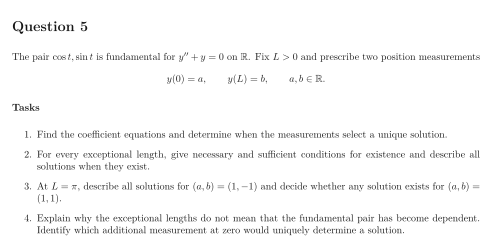
Step 3: Apply the classification. At , the data give The data fail the necessary condition and give no solution. The figure shows three members of the compatible family.
Step 4: Explain what failed. The data vectors of using value and slope at zero are and , so the pair remains fundamental. At , both endpoint positions are insensitive to the coefficient . Measuring fixes uniquely; the endpoint data must still be compatible with that solution.
See the diagram in the original worksheet below.