Question 6
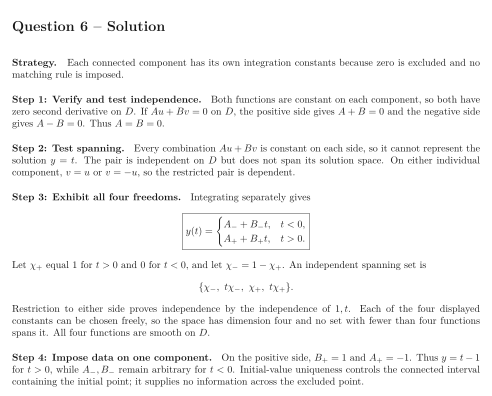
Let . On this disconnected domain, consider and the two functions A solution means a function on ; no matching condition at zero is imposed.
Tasks
Verify that both functions solve the equation and are linearly independent on .
Do their constant linear combinations represent every solution on ? Give a decisive counterexample and compare their independence on each connected component.
Find the full solution family on and an explicit independent spanning set. Prove why at least four functions are needed.
Describe every solution satisfying , . Explain why those data do not determine a unique solution on all of .
Show solutionHide solution
Question 6 – Solution
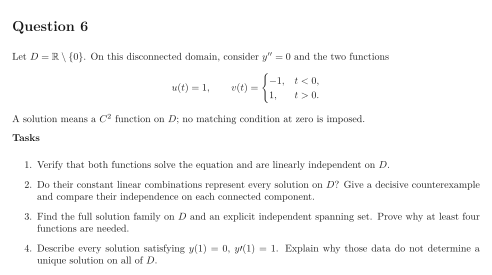
Strategy. Each connected component has its own integration constants because zero is excluded and no matching rule is imposed.
Step 1: Verify and test independence. Both functions are constant on each component, so both have zero second derivative on . If on , the positive side gives and the negative side gives . Thus .
Step 2: Test spanning. Every combination is constant on each side, so it cannot represent the solution . The pair is independent on but does not span its solution space. On either individual component, or , so the restricted pair is dependent.
Step 3: Exhibit all four freedoms. Integrating separately gives Let equal for and for , and let . An independent spanning set is Restriction to either side proves independence by the independence of . Each of the four displayed constants can be chosen freely, so the space has dimension four and no set with fewer than four functions spans it. All four functions are smooth on .
Step 4: Impose data on one component. On the positive side, and . Thus for , while remain arbitrary for . Initial-value uniqueness controls the connected interval containing the initial point; it supplies no information across the excluded point.