Question 7
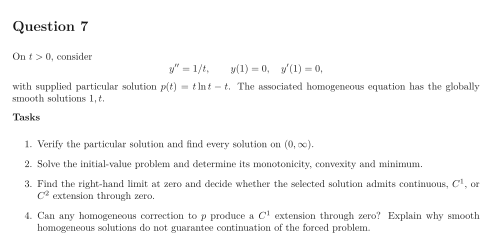
On , consider with supplied particular solution . The associated homogeneous equation has the globally smooth solutions .
Tasks
Verify the particular solution and find every solution on .
Solve the initial-value problem and determine its monotonicity, convexity and minimum.
Find the right-hand limit at zero and decide whether the selected solution admits continuous, , or extension through zero.
Can any homogeneous correction to produce a extension through zero? Explain why smooth homogeneous solutions do not guarantee continuation of the forced problem.
Show solutionHide solution
Question 7 – Solution
Strategy. The forcing can impose endpoint behavior that no homogeneous correction can cancel.
Step 1: Verify and complete. Since and , it is a particular solution. Adding all affine homogeneous functions gives
Step 2: Fit and analyze. The slope at gives , and the value then gives . Thus The function decreases on , increases on , and is strictly convex. Its unique global minimum is .
Step 3: Test extension of the selected function. Since as , we have . Setting and, for example, for gives a continuous extension. A finite derivative at zero is impossible because Hence there is no extension and therefore no extension. The limiting point in the graph is excluded from the original domain.
Step 4: Test every correction. For general , continuity would require , but the difference quotient is , again tending to . No finite homogeneous constants cure this. Although extend smoothly, the forcing is undefined at zero. The maximal regular interval containing the initial point is , not all of .
See the diagram in the original worksheet below.
