Question 8
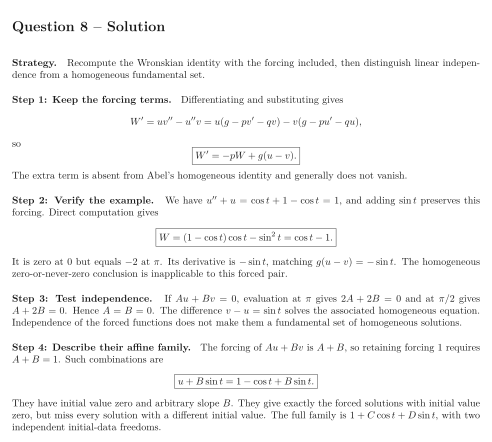
Let satisfy the same forced equation on a regular interval, and write . For a concrete example on , take
Tasks
Derive the differential identity for when the common forcing is nonzero.
Verify that the example functions solve . Compute their Wronskian and explain why its zero at zero does not force it to vanish everywhere.
Prove that the two example functions are linearly independent as functions, and identify the homogeneous solution obtained from their difference.
Classify the constant affine combinations of that solve the same forced equation. Which initial values and slopes at zero can they attain, and do they give the entire forced solution set?
Show solutionHide solution
Question 8 – Solution
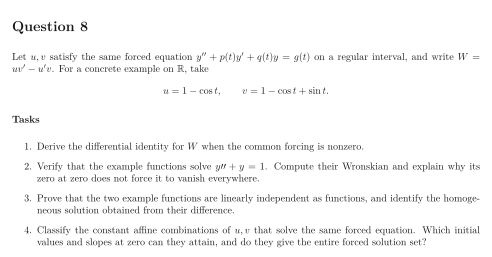
Strategy. Recompute the Wronskian identity with the forcing included, then distinguish linear independence from a homogeneous fundamental set.
Step 1: Keep the forcing terms. Differentiating and substituting gives so The extra term is absent from Abel’s homogeneous identity and generally does not vanish.
Step 2: Verify the example. We have , and adding preserves this forcing. Direct computation gives It is zero at but equals at . Its derivative is , matching . The homogeneous zero-or-never-zero conclusion is inapplicable to this forced pair.
Step 3: Test independence. If , evaluation at gives and at gives . Hence . The difference solves the associated homogeneous equation. Independence of the forced functions does not make them a fundamental set of homogeneous solutions.
Step 4: Describe their affine family. The forcing of is , so retaining forcing requires . Such combinations are They have initial value zero and arbitrary slope . They give exactly the forced solutions with initial value zero, but miss every solution with a different initial value. The full family is , with two independent initial-data freedoms.