Question 9
Let solve with . On , consider the approximation and the error . You may use for .
Tasks
Compute the residual and derive the differential equation and initial data satisfied by .
Verify by differentiating twice that solves this error initial-value problem. Justify that it equals .
Prove the rigorous error bound on , including the direction of the approximation error.
Find the exact solution by verification, compute the actual error at to six decimal places, and compare it with the bound. Why does a residual vanishing only at zero not prove exactness?
Show solutionHide solution
Question 9 – Solution
Strategy. Treat the approximation residual as a forcing for the error, then bound the resulting integral with a positive kernel.
Step 1: Form the error equation. Since , the residual is . Subtraction gives
Step 2: Verify the integral. Set . Leibniz differentiation gives Thus and . The continuous coefficients and forcing give uniqueness, so .
Step 3: Bound the error. For , the supplied sine inequality gives Hence overestimates the solution. The bound vanishes at zero and remains valid across the entire stated interval.
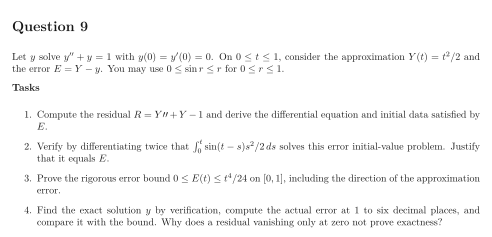
Step 4: Check against the exact response. The function has the required equation and zero data. Therefore The residual is zero at the initial point but is positive elsewhere on . A solution must satisfy its equation at every point, so agreement at one point and in the initial data does not make exact.
See the diagram in the original worksheet below.