Question 8
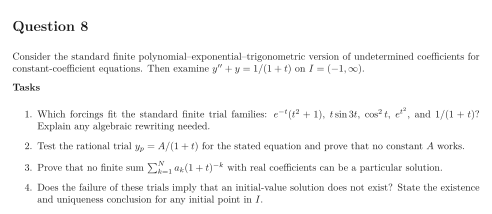
Consider the standard finite polynomial–exponential–trigonometric version of undetermined coefficients for constant-coefficient equations. Then examine on .
Tasks
Which forcings fit the standard finite trial families: , , , , and ? Explain any algebraic rewriting needed.
Test the rational trial for the stated equation and prove that no constant works.
Prove that no finite sum with real coefficients can be a particular solution.
Does the failure of these trials imply that an initial-value solution does not exist? State the existence and uniqueness conclusion for any initial point in .
Show solutionHide solution
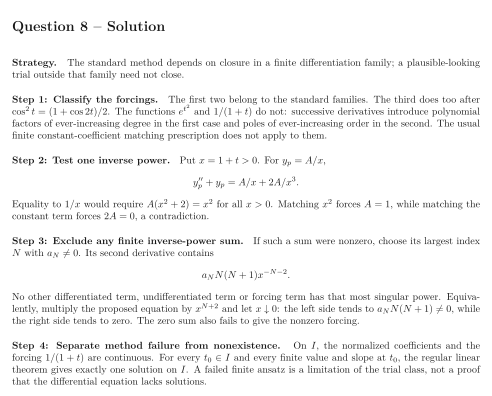
Question 8 – Solution
Strategy. The standard method depends on closure in a finite differentiation family; a plausible-looking trial outside that family need not close.
Step 1: Classify the forcings. The first two belong to the standard families. The third does too after . The functions and do not: successive derivatives introduce polynomial factors of ever-increasing degree in the first case and poles of ever-increasing order in the second. The usual finite constant-coefficient matching prescription does not apply to them.
Step 2: Test one inverse power. Put . For , Equality to would require for all . Matching forces , while matching the constant term forces , a contradiction.
Step 3: Exclude any finite inverse-power sum. If such a sum were nonzero, choose its largest index with . Its second derivative contains No other differentiated term, undifferentiated term or forcing term has that most singular power. Equivalently, multiply the proposed equation by and let : the left side tends to , while the right side tends to zero. The zero sum also fails to give the nonzero forcing.
Step 4: Separate method failure from nonexistence. On , the normalized coefficients and the forcing are continuous. For every and every finite value and slope at , the regular linear theorem gives exactly one solution on . A failed finite ansatz is a limitation of the trial class, not a proof that the differential equation lacks solutions.