Question 9
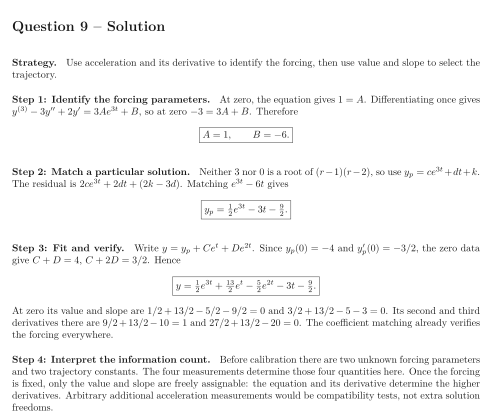
An unknown forcing in has two real constants . An exact response on has measured data
Tasks
Determine using the equation and its derivative at zero before solving for .
Choose a complete nonresonant trial and compute a particular solution for the identified forcing.
Fit the homogeneous correction and verify all four measured quantities.
Explain the distinct roles of the four measurements. Once are fixed, are four freely prescribed initial quantities available for this second-order equation?
Show solutionHide solution
Question 9 – Solution
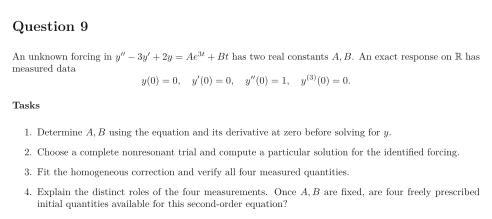
Strategy. Use acceleration and its derivative to identify the forcing, then use value and slope to select the trajectory.
Step 1: Identify the forcing parameters. At zero, the equation gives . Differentiating once gives , so at zero . Therefore
Step 2: Match a particular solution. Neither nor is a root of , so use . The residual is . Matching gives
Step 3: Fit and verify. Write . Since and , the zero data give , . Hence At zero its value and slope are and . Its second and third derivatives there are and . The coefficient matching already verifies the forcing everywhere.
Step 4: Interpret the information count. Before calibration there are two unknown forcing parameters and two trajectory constants. The four measurements determine those four quantities here. Once the forcing is fixed, only the value and slope are freely assignable: the equation and its derivative determine the higher derivatives. Arbitrary additional acceleration measurements would be compatibility tests, not extra solution freedoms.