Question 10
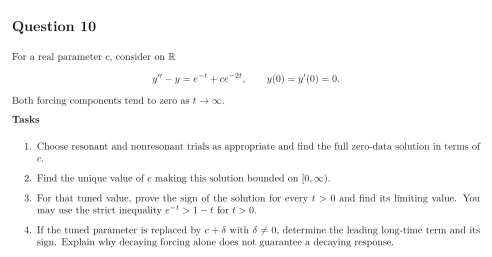
For a real parameter , consider on Both forcing components tend to zero as .
Tasks
Choose resonant and nonresonant trials as appropriate and find the full zero-data solution in terms of .
Find the unique value of making this solution bounded on .
For that tuned value, prove the sign of the solution for every and find its limiting value. You may use the strict inequality for .
If the tuned parameter is replaced by with , determine the leading long-time term and its sign. Explain why decaying forcing alone does not guarantee a decaying response.
Show solutionHide solution
Question 10 – Solution
Strategy. Determine which forcing combination cancels the growing homogeneous mode after the initial data are fitted.
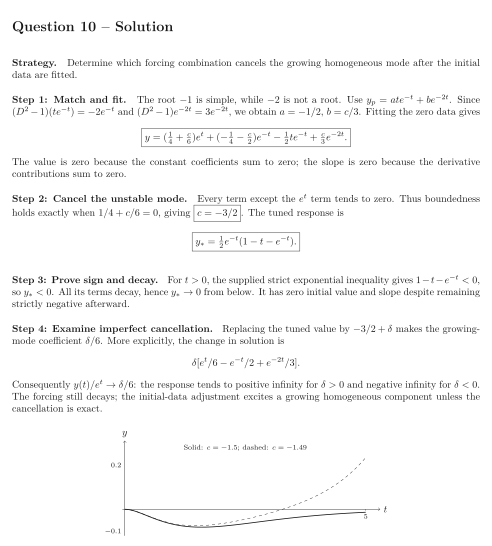
Step 1: Match and fit. The root is simple, while is not a root. Use . Since and , we obtain , . Fitting the zero data gives The value is zero because the constant coefficients sum to zero; the slope is zero because the derivative contributions sum to zero.
Step 2: Cancel the unstable mode. Every term except the term tends to zero. Thus boundedness holds exactly when , giving . The tuned response is
Step 3: Prove sign and decay. For , the supplied strict exponential inequality gives , so . All its terms decay, hence from below. It has zero initial value and slope despite remaining strictly negative afterward.
Step 4: Examine imperfect cancellation. Replacing the tuned value by makes the growing-mode coefficient . More explicitly, the change in solution is Consequently : the response tends to positive infinity for and negative infinity for . The forcing still decays; the initial-data adjustment excites a growing homogeneous component unless the cancellation is exact.
See the diagram in the original worksheet below.