Question 1
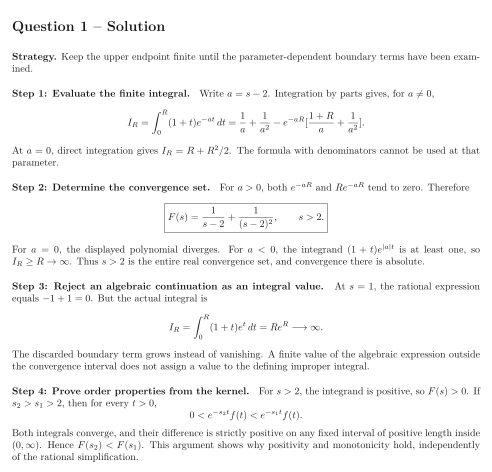
For real , use whenever this ordinary improper integral converges.
Let for . A student obtains the expression and claims that it gives a transform value at every real .
Tasks
Evaluate the truncated defining integral from zero to , treating separately.
Determine exactly which real give convergence, and find on that set.
Evaluate the student’s expression at and explain why it cannot be the Laplace integral there.
Prove directly from the integral, without differentiating the final formula, that is positive and strictly decreasing throughout its convergence interval.
Show solutionHide solution
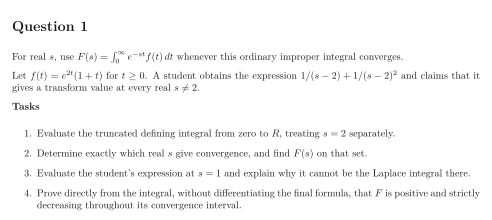
Question 1 – Solution
Strategy. Keep the upper endpoint finite until the parameter-dependent boundary terms have been examined.
Step 1: Evaluate the finite integral. Write . Integration by parts gives, for , At , direct integration gives . The formula with denominators cannot be used at that parameter.
Step 2: Determine the convergence set. For , both and tend to zero. Therefore For , the displayed polynomial diverges. For , the integrand is at least one, so . Thus is the entire real convergence set, and convergence there is absolute.
Step 3: Reject an algebraic continuation as an integral value. At , the rational expression equals . But the actual integral is The discarded boundary term grows instead of vanishing. A finite value of the algebraic expression outside the convergence interval does not assign a value to the defining improper integral.
Step 4: Prove order properties from the kernel. For , the integrand is positive, so . If , then for every , Both integrals converge, and their difference is strictly positive on any fixed interval of positive length inside . Hence . This argument shows why positivity and monotonicity hold, independently of the rational simplification.