Question 2
For real , use whenever this ordinary improper integral converges.
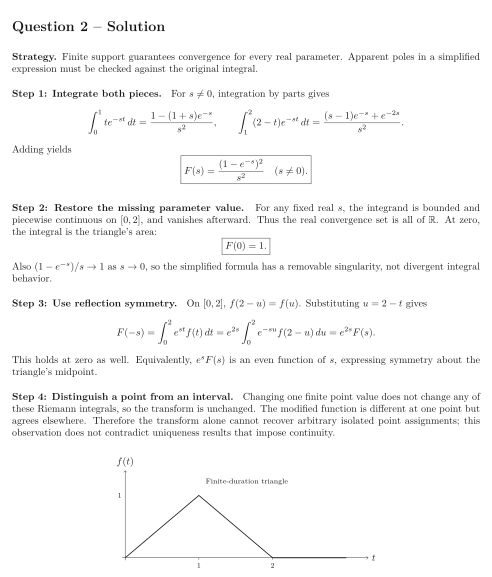
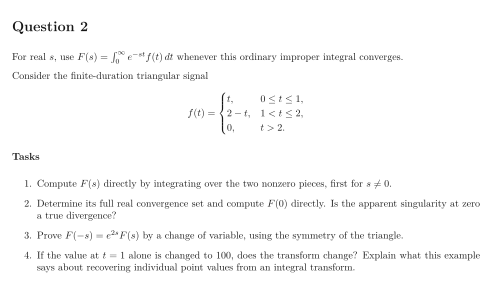
Consider the finite-duration triangular signal
Tasks
Compute directly by integrating over the two nonzero pieces, first for .
Determine its full real convergence set and compute directly. Is the apparent singularity at zero a true divergence?
Prove by a change of variable, using the symmetry of the triangle.
If the value at alone is changed to , does the transform change? Explain what this example says about recovering individual point values from an integral transform.
Show solutionHide solution
Question 2 – Solution
Strategy. Finite support guarantees convergence for every real parameter. Apparent poles in a simplified expression must be checked against the original integral.
Step 1: Integrate both pieces. For , integration by parts gives Adding yields
Step 2: Restore the missing parameter value. For any fixed real , the integrand is bounded and piecewise continuous on , and vanishes afterward. Thus the real convergence set is all of . At zero, the integral is the triangle’s area: Also as , so the simplified formula has a removable singularity, not divergent integral behavior.
Step 3: Use reflection symmetry. On , . Substituting gives This holds at zero as well. Equivalently, is an even function of , expressing symmetry about the triangle’s midpoint.
Step 4: Distinguish a point from an interval. Changing one finite point value does not change any of these Riemann integrals, so the transform is unchanged. The modified function is different at one point but agrees elsewhere. Therefore the transform alone cannot recover arbitrary isolated point assignments; this observation does not contradict uniqueness results that impose continuity.
See the diagram in the original worksheet below.