Question 3
For real , use whenever this ordinary improper integral converges.
Let for . Its truncated transform is .
Tasks
Evaluate for real , retaining its upper-endpoint contribution.
Find the exact real convergence interval for and determine whether convergence there is absolute.
At , exhibit two sequences of upper endpoints giving different values of .
Compare with the existence of . Why does a finite parameter limit not justify interchanging the two limits and ?
Show solutionHide solution
Question 3 – Solution
Strategy. Damping by can create convergence that disappears at the boundary parameter.
Step 1: Keep the endpoint term. Two integrations by parts, or differentiation of the resulting antiderivative, give There is no real zero of the denominator, but that alone says nothing about the limit as .
Step 2: Classify convergence. If , the endpoint term vanishes and Absolute convergence follows from . If , take . Then , so the improper integral cannot converge.
Step 3: Test the boundary directly. At , . For The two sequences tend to infinity but have different integral values. Thus does not exist, and the full real convergence interval is .
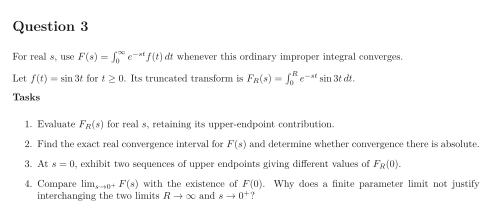
Step 4: Separate the two limiting procedures. The damped transforms satisfy . In contrast, setting first produces an oscillating truncated integral with no limit. For fixed , the limit in exists, but convergence in is not uniform as damping disappears. The value is a limit of damped integrals, not the value of the undamped improper integral. The graph compares accumulated integrals, not the original sine signal.
See the diagram in the original worksheet below.