Question 1
Use causal one-sided Laplace transforms. Write for and for . Ordinary functions are zero for . Justify the table entries and operational rules you use; give exact expressions.
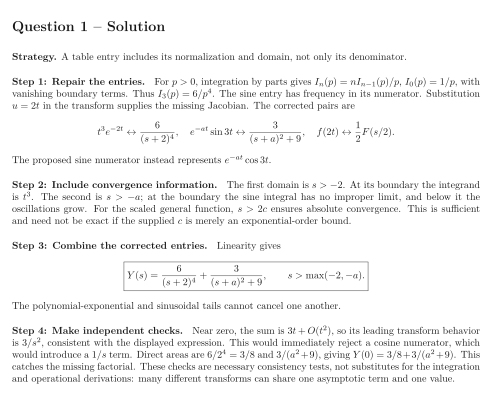
A draft transform table contains these three proposed pairs, with : In the third pair , where is continuous and of exponential order.
Tasks
Identify and correct every error. Derive the power entry by integration by parts and the scaling entry by substitution.
State the exact real convergence domains for the first two corrected entries. State the sufficient transformed domain for the third if converges absolutely for .
Use the corrected rules to find the transform of , without a fresh integration.
Check your answer independently using the leading large- behavior and the value at . Explain what each check can and cannot establish.
Show solutionHide solution
Question 1 – Solution
Strategy. A table entry includes its normalization and domain, not only its denominator.
Step 1: Repair the entries. For , integration by parts gives , , with vanishing boundary terms. Thus . The sine entry has frequency in its numerator. Substitution in the transform supplies the missing Jacobian. The corrected pairs are The proposed sine numerator instead represents .
Step 2: Include convergence information. The first domain is . At its boundary the integrand is . The second is ; at the boundary the sine integral has no improper limit, and below it the oscillations grow. For the scaled general function, ensures absolute convergence. This is sufficient and need not be exact if the supplied is merely an exponential-order bound.
Step 3: Combine the corrected entries. Linearity gives The polynomial-exponential and sinusoidal tails cannot cancel one another.
Step 4: Make independent checks. Near zero, the sum is , so its leading transform behavior is , consistent with the displayed expression. This would immediately reject a cosine numerator, which would introduce a term. Direct areas are and , giving . This catches the missing factorial. These checks are necessary consistency tests, not substitutes for the integration and operational derivations: many different transforms can share one asymptotic term and one value.