Question 2
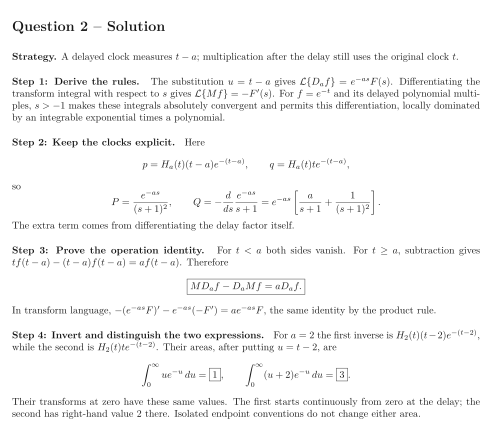
Use causal one-sided Laplace transforms. Write for and for . Ordinary functions are zero for . Justify the table entries and operational rules you use; give exact expressions.
For , define the delay and time-multiplication operations Take , and compare with .
Tasks
Derive the transform rules for and from their defining integrals. State a domain where the derivations are justified for this .
Find and their transforms. Explain exactly why applying the two operations in opposite orders changes the answer.
Prove the general identity whenever the expressions are defined, and verify its transform.
For , invert and . Compute the area of each inverse and use it to distinguish them.
Show solutionHide solution
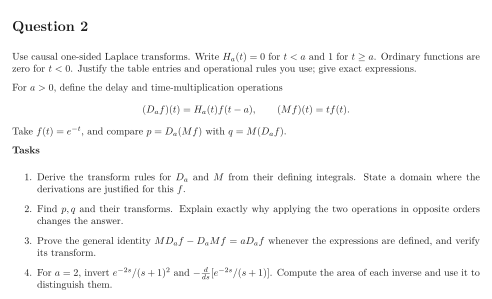
Question 2 – Solution
Strategy. A delayed clock measures ; multiplication after the delay still uses the original clock .
Step 1: Derive the rules. The substitution gives . Differentiating the transform integral with respect to gives . For and its delayed polynomial multiples, makes these integrals absolutely convergent and permits this differentiation, locally dominated by an integrable exponential times a polynomial.
Step 2: Keep the clocks explicit. Here so The extra term comes from differentiating the delay factor itself.
Step 3: Prove the operation identity. For both sides vanish. For , subtraction gives . Therefore In transform language, , the same identity by the product rule.
Step 4: Invert and distinguish the two expressions. For the first inverse is , while the second is . Their areas, after putting , are Their transforms at zero have these same values. The first starts continuously from zero at the delay; the second has right-hand value there. Isolated endpoint conventions do not change either area.