Question 7
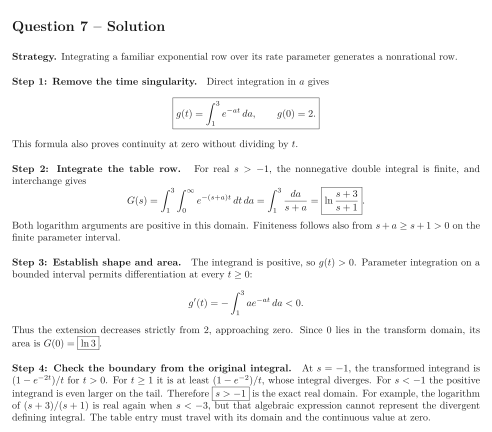
Use causal one-sided Laplace transforms. Write for and for . Ordinary functions are zero for . Justify the table entries and operational rules you use; give exact expressions.
For , let A rational-only table offers no obvious row for this function.
Tasks
Extend continuously to zero and represent it as an integral of exponential functions over a finite parameter interval.
Use that representation to derive its transform, carefully justifying interchange and specifying a real domain.
Prove positivity and strict decrease on , and compute the total area.
Find the exact real transform domain, including a proof of divergence at its boundary. Explain why an algebraically real continuation of a logarithm is not sufficient evidence of transform convergence.
Show solutionHide solution
Question 7 – Solution
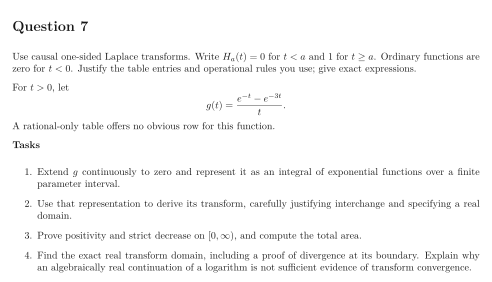
Strategy. Integrating a familiar exponential row over its rate parameter generates a nonrational row.
Step 1: Remove the time singularity. Direct integration in gives This formula also proves continuity at zero without dividing by .
Step 2: Integrate the table row. For real , the nonnegative double integral is finite, and interchange gives Both logarithm arguments are positive in this domain. Finiteness follows also from on the finite parameter interval.
Step 3: Establish shape and area. The integrand is positive, so . Parameter integration on a bounded interval permits differentiation at every : Thus the extension decreases strictly from , approaching zero. Since lies in the transform domain, its area is .
Step 4: Check the boundary from the original integral. At , the transformed integrand is for . For it is at least , whose integral diverges. For the positive integrand is even larger on the tail. Therefore is the exact real domain. For example, the logarithm of is real again when , but that algebraic expression cannot represent the divergent defining integral. The table entry must travel with its domain and the continuous value at zero.