Question 8
Use causal one-sided Laplace transforms. Write for and for . Ordinary functions are zero for . Justify the table entries and operational rules you use; give exact expressions.
Consider the transform . Allow a full-mass impulse at the origin, with and pre-impact data at . For ordinary candidates, restrict to functions continuous near zero and of exponential order. The input with transform drives
Tasks
Explain why cannot be the transform of an ordinary candidate in the stated class. Recover its distributional inverse.
Find and the complete response for , including the jump at zero.
Find the positive zero, the global minimum, and the total response area. Explain how a nonzero response can have zero area.
Verify the post-impact equation and the equivalent ordinary restart. State the exact real transform domain of the response.
Show solutionHide solution
Question 8 – Solution
Strategy. Divide an improper rational expression before consulting ordinary-function rows. Its polynomial part may represent an impulse.
Step 1: Identify the input class. For an ordinary candidate continuous near zero and of exponential order, its Laplace transform tends to zero as : the bounded initial piece has integral and the exponentially bounded tail tends to zero. But . Polynomial division gives The impulse supplies the nonvanishing constant term.
Step 2: Transform the equation and account for the jump. With the stated pre-impact convention, , so Write . Integrating across zero gives , consistent with . The negative exponential input has no impulse mass.
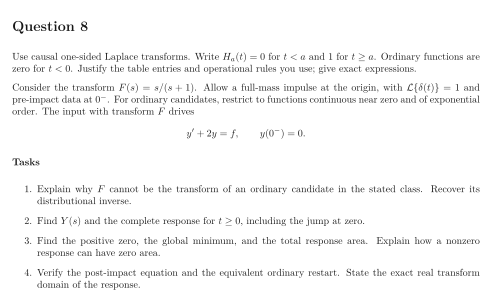
Step 3: Find the sign changes and area. The unique positive zero is . The derivative is , negative before and positive afterward. Thus the global minimum is . The area is : positive and negative parts cancel. For comparison, the signed input area is when the full initial impulse is included.
Step 4: Verify the ordinary restart and convergence. For , direct substitution gives . The same response solves this ordinary equation with . Adding another initial impulse to that restart would count it twice. The tail is asymptotic to , so the exact real transform domain is . The figure shows only the post-impact branch on ; the filled initial point records the prescribed right-hand value.
See the diagram in the original worksheet below.