Question 4
For real , write where the integral converges.
Let and . The transform of is for .
Tasks
Derive the transform rule for by integration by parts, showing where the zero initial value and the boundary at infinity enter.
Find an elementary expression for , its transform , and the exact real convergence interval of .
Set . Find its transform and convergence interval, including its value at . Explain why cancellation can enlarge the interval.
Find the first maximum of and its height. Does integration of this exponentially decaying input produce an exponentially decaying or monotone cumulative response?
Show solutionHide solution
Question 4 – Solution
Strategy. A cumulative integral may retain a nonzero constant even when its input decays. Its transform domain must be checked anew.
Step 1: Derive the cumulative rule. Here , , and is bounded because is absolutely integrable. For , integration by parts gives The initial term is zero and the upper term vanishes because is bounded. Thus on this half-line.
Step 2: Determine the response and its domain. An antiderivative gives The formula satisfies and . Since , it is eventually bounded below by a positive constant. Its transform therefore diverges for every . The cumulative response has a smaller convergence interval than the input.
Step 3: Remove the persistent constant. Now . Transforming these two terms directly gives It converges absolutely there; at and below the nondecaying or growing trigonometric tail prevents ordinary convergence. In particular, : its signed areas cancel. The identity is initially valid only for . The wider domain follows from the actual centered function, not by subtracting divergent integrals at .
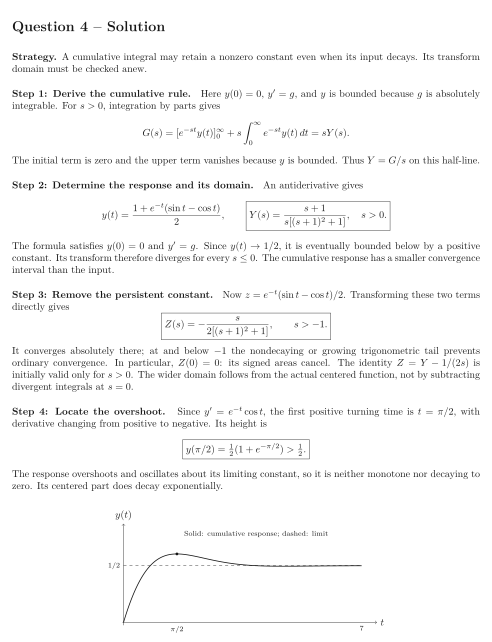
Step 4: Locate the overshoot. Since , the first positive turning time is , with derivative changing from positive to negative. Its height is The response overshoots and oscillates about its limiting constant, so it is neither monotone nor decaying to zero. Its centered part does decay exponentially.
See the diagram in the original worksheet below.