Question 6
For real , write where the integral converges.
For , define and extend it continuously to . This example concerns division by time; do not assume a transform rule for dividing an arbitrary function by .
Tasks
Find and express as an integral of over a finite interval in .
Use that representation to derive the transform and justify the order of integration.
Find the exact real convergence interval. Explain why transforming and separately is invalid.
Find and . Relate them to positivity of and its value at zero.
Show solutionHide solution
Question 6 – Solution
Strategy. Cancellation removes the origin singularity. Preserve that cancellation by integrating over an exponential parameter.
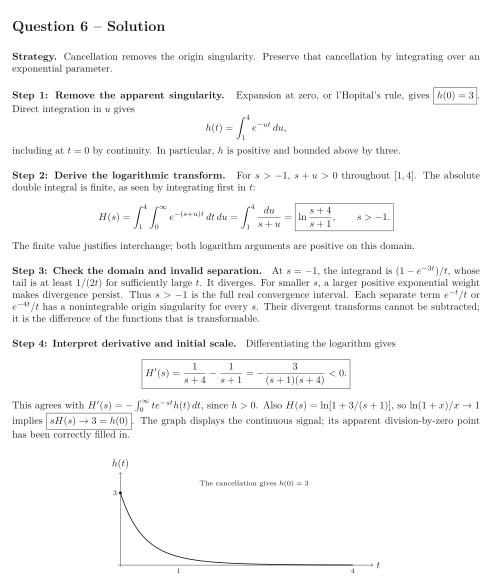
Step 1: Remove the apparent singularity. Expansion at zero, or l’Hopital’s rule, gives . Direct integration in gives including at by continuity. In particular, is positive and bounded above by three.
Step 2: Derive the logarithmic transform. For , throughout . The absolute double integral is finite, as seen by integrating first in : The finite value justifies interchange; both logarithm arguments are positive on this domain.
Step 3: Check the domain and invalid separation. At , the integrand is , whose tail is at least for sufficiently large . It diverges. For smaller , a larger positive exponential weight makes divergence persist. Thus is the full real convergence interval. Each separate term or has a nonintegrable origin singularity for every . Their divergent transforms cannot be subtracted; it is the difference of the functions that is transformable.
Step 4: Interpret derivative and initial scale. Differentiating the logarithm gives This agrees with , since . Also , so implies . The graph displays the continuous signal; its apparent division-by-zero point has been correctly filled in.
See the diagram in the original worksheet below.