Question 9
For real , write where the integral converges.
A nonnegative density on has the form with , and . Define its mean by and variance by . An exact measurement gives .
Tasks
Determine the relation between from normalization and compute the transform.
Derive the first two moment identities using parameter differentiation. Recover and the variance from the measured mean.
Could this same family have mean and variance ? Give an exact consistency relation for arbitrary positive mean.
Find the location of the density maximum for the recovered parameters and compare it with the mean. Explain why those locations differ.
Show solutionHide solution
Question 9 – Solution
Strategy. Normalization fixes one parameter, while derivatives of the transform at zero recover moments. A density’s peak is not its mean.
Step 1: Normalize and transform. Integration by parts gives . Thus , and exponential shifting yields The nonnegative polynomial-exponential tail diverges at or below . In particular, , as normalization requires.
Step 2: Extract moments and parameters. Since zero lies strictly inside the convergence interval, exponential decay justifies differentiation near zero: The rational expression gives and . Hence From , we obtain
Step 3: Test consistency rather than refitting. Eliminating gives . Thus mean four forces variance eight, and the pair is incompatible with this family. Changing cannot repair it because normalization already fixes .
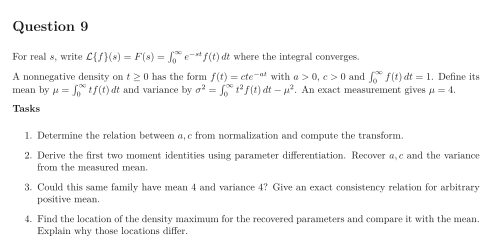
Step 4: Locate the peak. For general , , positive before and negative afterward. The unique density maximum is therefore at , while the mean is four. The long right tail contributes to the mean; the point of largest density measures a different feature. The graph marks both the mode and the mean for .
See the diagram in the original worksheet below.